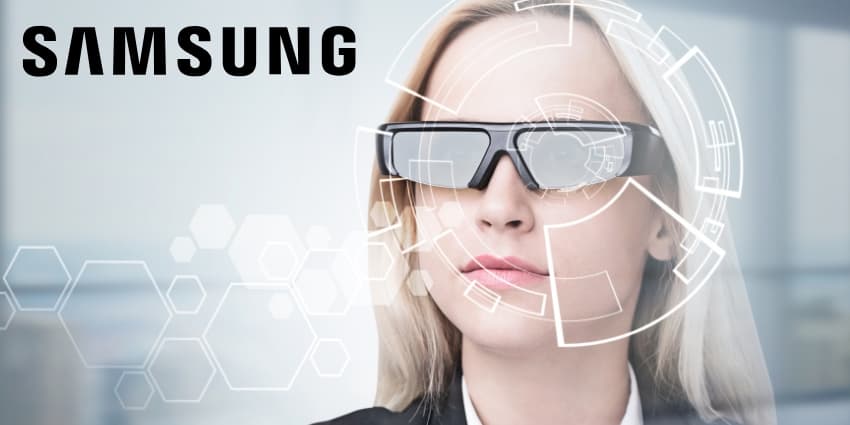
Rumors about an impending set of Samsung Smart Glasses have been circulating for a while now. Samsung’s team has dropped plenty of hints that the company is planning on entering the XR market.
They even confirmed at the “Unpacked 2024” event that an XR device would be arriving soon. Unfortunately, the company has been a little stingy with the details. Recent leaks suggest that Samsung could enter the “smart wearables” market sooner than we thought.
According to a leak revealed at the end of October 2024, Samsung filed a patent with the United States Patent and Trademark Office, for a “system” that enables the grouping plurality of devices – suggesting a pair of AR specs could be on the horizon.
Later, in November, another leak emerged suggesting Samsung will use its partnership with Google and Qualcomm to release a pair of AI smart glasses similar to the Meta Ray-Ban glasses.
So, what does all of this mean? Will customers be able to purchase a set of Samsung smart glasses in 2025? Will they have augmented reality features or rely entirely on AI?
Here’s what we know so far.
Samsung Smart Glasses Could be Rolling Out in 2025
As mentioned above, Samsung has been telling customers that it’s been working on an XR wearable for a while now since it confirmed its partnership with Google and Qualcomm early in 2024.
However, we haven’t heard much about what this device will be, or what it’ll be able to do until recently. In September 2024, Qualcomm announced it was working on a pair of smart glasses with Google and Samsung. They indicated that the wearables they’d be releasing would be similar in functionality to Meta’s Ray-Ban specs.
In November this year, a Korean newspaper reported on a leak that Samsung is apparently planning an “initial run” of intelligent glasses consisting of around 500,000 units—set to be released in the third quarter of 2025 (between July and September).
That release date makes sense, as it lines up with Samsung’s “Unpacked” event, which typically launches next-generation products like the new smartphones and Galaxy Ring announced this year.
However, it’s worth noting that this release date isn’t necessarily set in stone. Samsung’s TM Roh also said the company was considering releasing an XR device in 2024, which obviously hasn’t happened. Still, everything seems promising – at least for now.
The Samsung Smart Glasses: AR or Just AI?
So, will these glasses be true augmented reality wearables? Or are they just going to give you access to a hands-free smart assistant, like the Meta Ray-Bans? For now, we’re not really sure. Based on leaks, we do know that the glasses will use a Qualcomm chip – no surprise there. Right now, they seem to feature an AR1 chip.
However, Qualcomm has released its AR2 chipset, so there’s a chance the specs could see an update before they’re officially launched next year. We also know that the glasses will apparently feature a 155mAh battery and a 12MP Sony camera built-in. If these specs sound familiar, it’s because they’re almost exactly what you’ll get from the Meta Ray-Ban glasses, too.
Unfortunately, most of the leaks don’t mention any kind of display for augmented reality experiences, and the rumored weight of the glasses (about 50g) doesn’t leave much space for an actual display. However, that doesn’t necessarily mean that Samsung won’t include augmented reality in its specs.
The patent leak from October directly references augmented reality technology. It suggests that users can interact with AR content by connecting to another device (like a smartphone). Plus, it’s worth noting that Samsung’s glasses, while lightweight, do seem to be a little heavier than the Ray-Ban specs – so there may be hope for AR yet.
The AI Technology: Google Gemini
Even if Samsung doesn’t add augmented reality to these glasses, they won’t give users the exact same experience as they’d get from the Meta Ray-Bans. That’s because Samsung’s glasses will feature a very different smart assistant—a custom version of Google’s Gemini LLM.
The built-in Gemini assistant could make Samsung’s glasses more appealing for a broader range of use cases. While Meta’s AI assistant is handy, it focuses primarily on supporting content creators. Leaks around the Samsung glasses suggest the assistant can handle tasks like payment with QR code recognition.