At the beginning of this year, mobile access for unified communications was already a business essential. The trend was further compounded by the pandemic and the rise of distributed workforces.
An early-2020 survey found that 59% of us use at least three devices at work, including mobile platforms. Even before the pandemic, over 38% had team members working remotely, with 1 in 5 relying heavily on mobile.
In 2021, mobility, mobile UC, and Fixed Mobile Convergence (FMC) must be at the forefront of UC investments. With many employees continuing to stay remote and others partially returning to a physical workplace, these technologies will help remove any fragmentation in your communication landscape. Interestingly, fragmentation caused a staggering 60% of employees to face a communication crisis at least once a month last year.
The team at UC Today was eager to explore pragmatic tactics for addressing this challenge, maintaining productivity in the new normal.
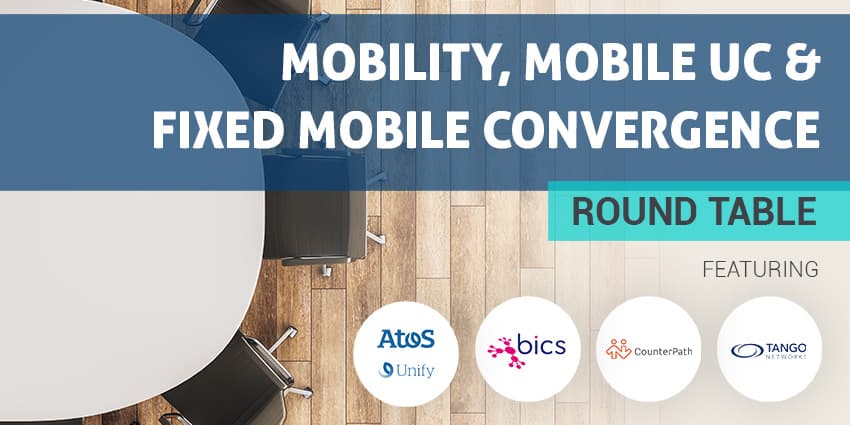
We asked experts from Unify (Atos), BICS, CounterPath, and Tango Networks about the most pressing challenges for mobile UC in 2020-2021. Atos is a global digital transformation leader that acquired UC company, Unify, in 2016. BICS is a multinational roaming and mobile connectivity solutions provider, CounterPath is known for its enterprise UC products, specifically VoIP. And Tango Networks offers a private mobile network for business users powered by the cloud.
Here’s what our experts had to say.
In relation to mobile UC (mobility & Fixed Mobile Convergence), what are the biggest challenges faced by businesses today?
2020 was a watershed year for workplaces in general, and mobile communications in particular. Companies have had to ramp up their adoption strategies, often leading to unplanned investments. There’s massive demand in the market, that could lead to a flurry of activity for mobile UC and FMC businesses – but this also leads to a number of challenges.
Hear from our experts:
Mark Smith, Chief Marketing Officer at Unify:
Right at the outset, Unify’s Mark Smith mentioned how the pandemic accelerated existing trends in mobile UC. this causes two problems:
- Sunk costs - “Many people are working from home, but organisations still have the cost of Fixed and Mobile which are not being utilised,” Smith pointed out
- Management of user-owned devices - “For many organisations, keeping up with the device in users’ pockets is next to impossible. This has been exacerbated by Covid-19,” he added
Digital transformation was already exploding the mobile device landscape at the beginning of this year. Now, with employees using their personal devices for work more than ever (often without organisational oversight), companies are hard-pressed to maintain optimal utilisation of their end-to-end landscape.
Divya Wakankar, Head of Digital Communications at BICS:
Like Smith, BICS’ Divya Wakankar agreed that faster adoption is both the biggest challenge and opportunity for the industry.
“COVID-19 has sped up digitalisation timelines in the enterprise communications and collaboration space. The emergence of a new, flexible, hybrid office/remote working environment requires new ways of communicating. This includes collaborating through different applications, accessible via fixed or mobile devices,” mentioned Wakankar.
“We’re seeing demand from enterprises and contact centres for numbers in different countries, delivering telecommunications through public clouds like AWS, GCP, or Microsoft Azure. They want to scale communications quickly, making speed another key challenge,” she said.
Wakankar shared the example of a Poland-based international contact centre with us. The contact centre would have to get numbers in different countries for pre- and post-sales support. But national Polish operators didn’t offer this sort of international connectivity support. “Buying this locally would be impossible for them, as they’d have to set up multiple local partnerships, at great cost, both initially and in terms of maintenance,” she explained.
To intersect speed, cost efficiency, and scale is a major challenge, which is why several organisations turn to the cloud.
Todd Carothers, CRO at CounterPath:
CounterPath’s Todd Carothers broke down the mobile UC and FMC market landscape into three clear challenges.
- Security - “Signalling and media must be secure for communications outside of the building. Security should involve standards-based technologies instead of proprietary mechanisms, as the latter may not be fully understood by IT departments,” recommended Carothers
- Maintaining quality - “Many UC solutions don’t focus on mobility as a priority, so it risks becoming a simple add-on,” warned Carothers. In such scenarios, users are stuck with a subpar UX when going mobile
- Integrating UC into business workflows - Some providers choose to put the cart before the horse, in that they first provide an offering and then make enterprises incorporate it into business workflows. “This is problematic as it reduces productivity and increases costs,” he said
Mobile UC customers should look out for solutions that come with rich APIs or SDKs. “These can be leveraged by novice developers to better enable the UC solution to align with business workflows,” suggested Carothers.
Andrew Bale, General Manager - Cloud Services at Tango Networks:
Tango Networks’ Andrew Bale spoke about an interesting dichotomy that often exists between mobile devices and the UC discipline as a whole.
“2020 research showed that businesses who adopt UC can achieve measurable gains in productivity and cost savings compared to peers. However, moving these benefits over to the mobile phone – today’s communications device-of-choice – can start to lose all of the benefits of UC,” he noted.
Companies need a way to make mobile phones and UC co-exist on the same plane, maximising the benefits of both.
Unfortunately, this is hindered by the fact that mobile phone companies just aren’t very open, said Bale. “The only way to date of integrating mobile phones into a UC service has been by the use of ‘over-the-top apps.’ With the increasing move to work-from-home programs, the problem is just getting worse,” he added.
Right now, only 5.6% of companies regularly use such apps, making this a major pain point to be addressed on the way forward.
What can be done to address these challenges?
2021 will witness several companies getting on the winning side of these challenges as they become more familiar with the new normal. They will restructure UC investments to prioritise mobility and empower IT to integrate better. Ultimately, we can look forward to the lines between mobility and UC getting increasingly blurred, as we approach a truly “unified” landscape.
Our experts shared their insights.
Mark Smith, Chief Marketing Officer at Unify:
According to Unify’s Mark Smith, the answer lies in a strategic shift.
“Organisations should consider what relationship FMC will play in the new normal workplace,” he said.
How much of previous communication is now needed in the world of Video and WebRTC? How do you rejig the UC stack for applications which consume bandwidth rather than minutes? Can organisations reduce costs while also increasing effectiveness by moving to modern solutions? These will be some of the top questions to ask in 2021.
Another strategic shift that Smith mentioned was a mindset change regarding bring-your-own-device (BYOD).
“Organisations should revisit previous decisions regarding BYOD and enable users to access more applications on their devices through the use of smart, secure containers like Microsoft’s Company Portal,” he said. Such a methodology would allow users the flexibility to match their preferred mobile device to any given scenario, without compromising security.
BICS' Head of Digital Communications, Divya Wakankar:
BICS’ Divya Wakankar emphasised the potential of the cloud to solve some of the key challenges companies face today (see Poland contact centre example above). She calls this a “shift towards telecommunications-as-a-service.”
“It’s affordable, it’s scalable, and it helps customers deliver high-quality, international communications services. Crucially, it allows them to do so at speed,” Wakankar said.
During our conversation, she explained how BICS is working to fill the gap between demand and available mobile solutions. “As a service provider offering local cloud numbers at an international level, we allow enterprises and contact centres (like the example in Poland) to offer telecommunications services to their end-users. This is significantly more cost-efficient than if enterprises set up these relationships themselves,” she said.