Did you know that Unified Communications-as-a-Service (UCaaS) was among the top five spending priorities for businesses even before the pandemic?
Today, as more of us work from home (WFH) or other dispersed locations, UCaaS is an affordable, flexible, and powerful way of keeping employees connected. Nearly every communication provider is now exploring possibilities in the UCaaS segment – for example, Microsoft, which was once an enterprise cloud and standalone solutions provider, has shifted entirely into UCaaS.
It is the same story with the telecommunications company, Mitel, as well. Globally recognised for its PBX, VoIP, and contact centre solutions, it was recently ranked as “Best in Value for UCaaS.” On the other hand, there are industry giants like Vonage who are pure-play UCaaS platform providers, offering a clear, integrated product.
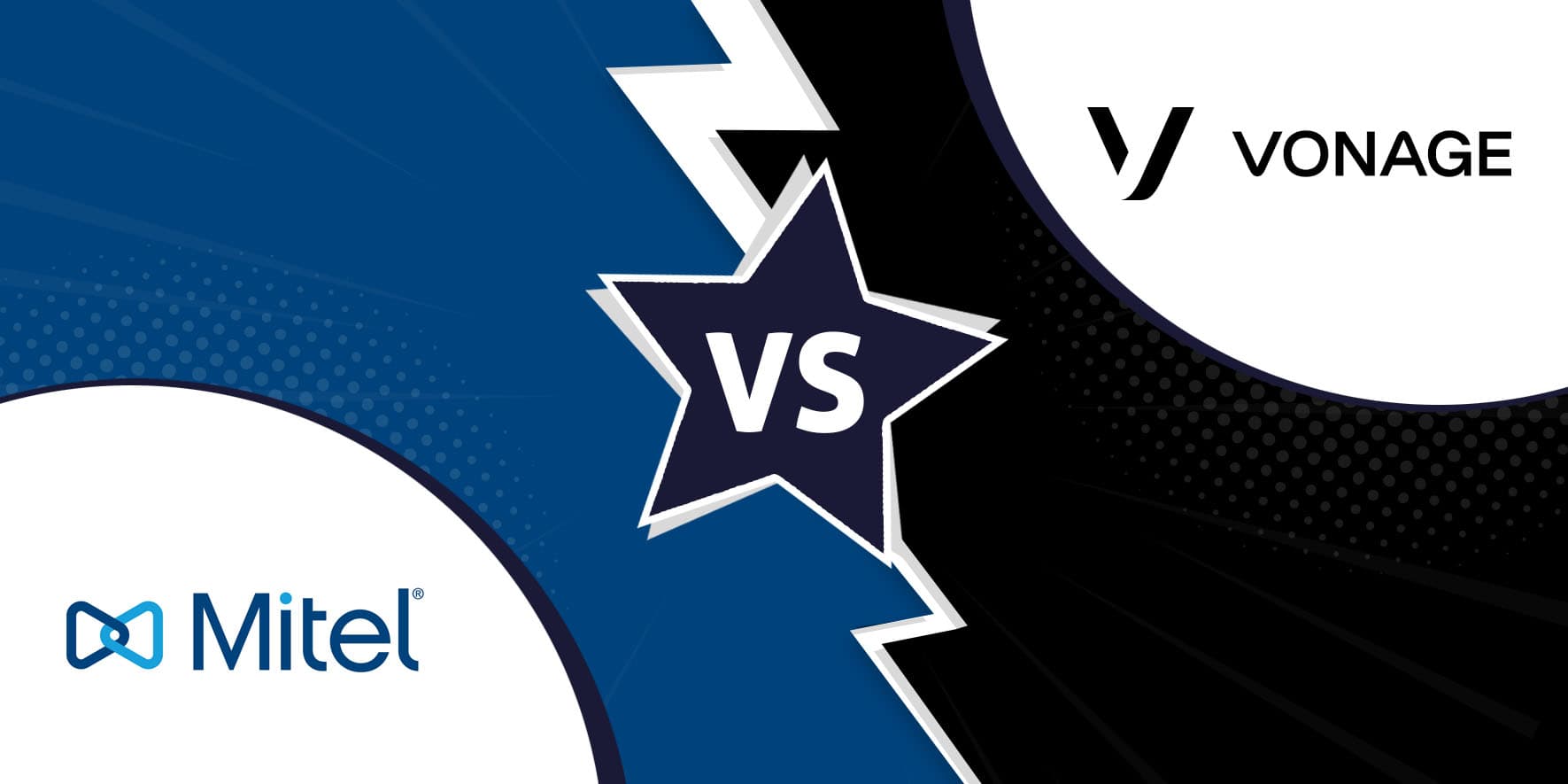
If you’re in the market for a UCaaS refresh in 2021, Mitel and Vonage should be on your vendor shortlist. Let us discuss how these two solutions stack up.
Mitel UCaaS Features
Mitel’s product line-up has everything you could possibly need for business communications.
It has three different cloud-based phone systems, with the option of deploying on-premise. Mitel’s own, branded endpoint line-up includes IP phones, SIP phones, conference phones, DECT phones, and even old-school analogue. The company’s platform for internal and contact centre collaboration helps to build an integrated hardware plus software landscape.
Companies have the flexibility of designing a custom UCaaS environment, picking and choosing the exact endpoints and software solutions that would make sense for them. For instance, a healthcare organisation might go heavy on DECT phones, empowering frontline workers on the move. A medium-sized knowledge services provider, however, might gain more from VoIP phones, and the Mitel MiCollab enterprise collaboration software.
If you are considering Mitel as a potential UCaaS partner, here are the features to expect:
- A diverse catalogue of telephony hardware, including wireless devices
- The MiCollab UCaaS platform consolidating chat, voice, video, mobility, and collaboration on a single interface
- On-premise, virtualised, or deployment on the public cloud
- Underlying cloud architecture built on AWS services
- Mobile apps for iOS and Android devices, as well as a web client
- 100% cloud-based collaboration via Mitel Teamwork
- Specialised solutions for contact centre including workforce optimisation, omnichannel capabilities, hosted solutions, etc.
Mitel powers approximately 1.4 million UCaaS customers around the world. Its strengths are hosted PBX and resilient VoIP, coupled with easy-to-use collaboration software technology.
Vonage UCaaS Features
Vonage is an early 2000s company that is globally recognised for its VoIP services. The company has two products – unified communications and contact centres – both implemented in a straightforward platform format.
Vonage UCaaS enables conversations on multiple channels such as voice, SMS, team messaging, fax, social, conferencing, and more, with the promise of 99.999% uptime. Here are some of the key features to expect:
- Mobility through VoIP functionalities on cell phones
- Paperless fax, virtual voicemail, and voicemail to email conversion
- VonageReach which is an SMS outreach automation technology
- Vonage Visual Voicemail at $4.99 per extension per month
- Collaboration via 30 participant conferences
- Paging groups and team messaging
- Customer service capabilities such as a receptionist control, call park, call queue, etc.
- Vonage Support Plus powered by Soluto, remote support for IT and tech issues
- Training and webinar sessions with up to 100 attendees
- Smart WAN (Vonage’s SD-WAN solution) for superior internet quality
Vonage follows a custom pricing model for mid-sized to large businesses, but if you have less than 100 employees, the pricing is fixed and tier-based, across three tiers: Mobile for $14.99 per month per line, Premium for $24.99, and Advanced for $34.99.