Manufacturing has always been about motion, materials moving, machines turning, people working in step. What’s shifting now is how all those movements stay in sync.
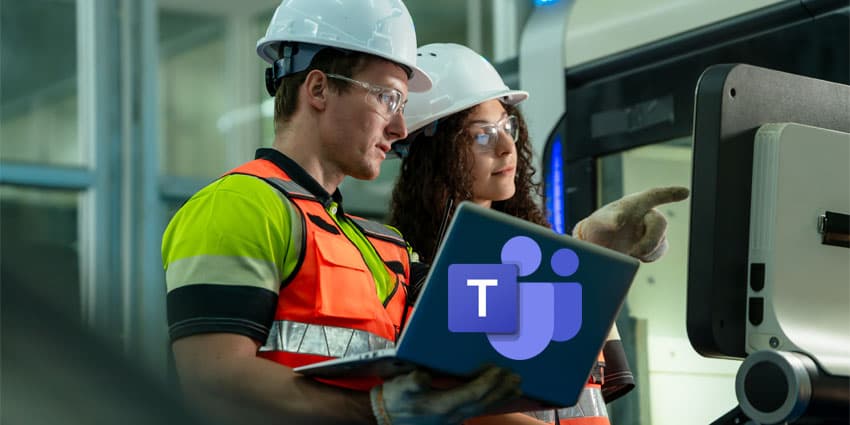
The same line worker who once juggled radio calls and paper logs now checks a shared dashboard on Microsoft Teams for Manufacturing. The engineer who used to wait hours for a maintenance report now sees an alert pop up mid-shift, complete with video from the shop floor.
Teams has become the connective tissue of the smart factory, a space where operations, safety, and data converge. It’s not a “chat app.” It’s a live workspace that bridges the divide between IT systems and operational technology, providing every technician, supervisor, and plant manager with a single view of what’s happening and the ability to act on it.
At Hannover Messe 2025, Microsoft showcased factories already utilizing this model with predictive maintenance insights delivered through Teams, Copilot drafting digital work instructions in seconds, and shift coordination occurring across continents in real time.
Deloitte’s 2025 Smart Manufacturing study found that more than 80 percent of manufacturers are now investing in this kind of digital connectivity. Today, a new industrial rhythm is emerging. The modern connected factory doesn’t just automate; it collaborates.
- Measuring and Maximizing Microsoft Teams ROI: The Enterprise Framework
- How CIOs Can Balance Microsoft Teams Governance with Productivity
Microsoft Teams and The Smart Manufacturing Imperative
Over the past decade, manufacturing has been reshaped by robotics, automation, and data dashboards glowing in every control room. Yet for all that progress, one problem keeps surfacing, people can’t move at the same speed as the machines they run. Messages get lost, reports lag behind, and a minor delay in one cell can ripple through an entire supply chain before anyone has time to react.
That gap is serious. Markets are volatile, orders change overnight, and downtime now costs more than power or raw materials. Every hour counts. The question for leaders isn’t how fast their systems can process data; it’s how quickly their people can act on it together.
In many ways, that’s why Microsoft Teams for Manufacturing has found traction where traditional ERP systems fall short. It’s providing production crews, line managers, and engineers with a shared workspace where information is transmitted in real-time. When the operator on Line 3 can instantly tag the maintenance planner, or when a quality alert from an IoT sensor lands in the right channel instead of someone’s inbox, coordination stops being a bottleneck.
Unifying Communication with Microsoft Teams for Manufacturing
In most factories, communication remains the primary source of friction. Production runs 24 hours a day, but information often moves at a snail's pace. Microsoft Teams for Manufacturing is starting to close that gap by turning routine updates into live collaboration.
At Florida Crystals, the world’s largest refiner and marketer of cane sugar, that shift came with a clear business case. The company replaced decades-old phone systems with Teams Phone and Teams Rooms, linking its plants across the US, Europe, and Latin America. The result: telecom costs dropped by 78 percent. More importantly, production teams could finally join meetings from anywhere on site, even from devices connected to analog equipment.
SMA Solar Technology AG made a similar move. The company standardized communication using Microsoft Teams and Teams Phone across its global operations, eliminating the maze of standalone systems that previously separated field engineers from central support. That connection enables project teams to handle client issues as they arise, rather than pushing them through endless email threads.
- Unlocking Microsoft Teams Phone’s True Business Value
- Microsoft Teams for Field Service: The Command Center Transforming Operations
Streamlining Operations and Maintenance
Every production manager knows the stillness that comes with a machine stopping. It’s the costliest sound on the floor. The faster information, tools, and people connect, the shorter that silence lasts. Microsoft Teams for Manufacturing is the link that’s cutting it down.
The platform has become a digital command center for maintenance and operations. When IoT sensors detect a temperature spike or vibration anomaly, alerts can surface directly in Teams through adaptive cards, automatically creating work orders in Dynamics 365 Field Service. The technician doesn’t have to hunt through multiple systems; the issue, documentation, and response plan appear in one channel, ready for action.
For AHW, a farm-equipment manufacturer, the problem was complexity. Too many systems, not enough IT staff. Moving to Microsoft 365 E5, which includes Teams Phone, Power Platform, and Microsoft Sentinel, pulled everything into one place. Now, service calls are open, routed, and closed in the same thread where technicians chat.
Driving Innovation with Microsoft Teams for Manufacturing
Innovation in manufacturing occurs on the line, between shifts, during troubleshooting chats, and in the midst of a problem that requires a swift solution. The companies that get ahead are the ones that find ways to capture that knowledge before it disappears into someone’s notebook.
That’s where Microsoft Teams for Manufacturing is changing habits that used to slow people down. Instead of relying on long debriefs or scattered reports, operators and engineers can record photos, notes, and voice messages directly into Teams. Those fragments become searchable, shareable knowledge that doesn’t vanish when the next shift clocks in.
Siemens Digital Industries Software pushed the idea further. It built a Teams app that works with Azure AI to listen, translate, and route problems as they happen. A worker can describe a defect in their own language, and the system instantly turns it into a clear report, files it in Teamcenter, and sends it to the right engineer.
When experience outpaces mistakes, quality improves. Teams makes that possible by keeping conversations, data, and knowledge in one place. Over time, it turns every plant into its own lab for innovation.
Connecting Business Functions and Customer Engagement
Every factory runs on two engines: production and information. One builds the product, the other builds trust inside the company and with customers. For years, those two worlds barely spoke. Engineers tracked performance in one system, sales in another, and finance in a separate system entirely. It made coordination a guessing game.
That gap is closing quickly. With Microsoft Teams for Manufacturing, cross-department conversations no longer disappear. They flow directly into live workflows, where supply alerts, customer notes, and production data are combined within the same thread, tied to a record in Dynamics 365 or another core system.