powering productive workplaces
Front page
NewsHCM Platforms2h · 15:01 BST · 5 min read

HCM Round Up: AI Investment, Workplace Data and Pay Rules

This week’s developments show how the impact of AI is extending beyond tech investment, with Salesforce backing HiBob’s workforce data strategy, Accenture highlighting the shift toward skills, California targeting emotion-recognition tools and a UK pay ruling testing the limits of workplace pay

HCM Round Up: AI Investment, Workplace Data and Pay Rules

There has been plenty happening in the HCM sphere this week, but the most telling stories have centered on what happens after a company decides to use AI. Buying tools is one thing. Working out what information those tools should use, how employees will be managed around them and where legal limits should sit is another.

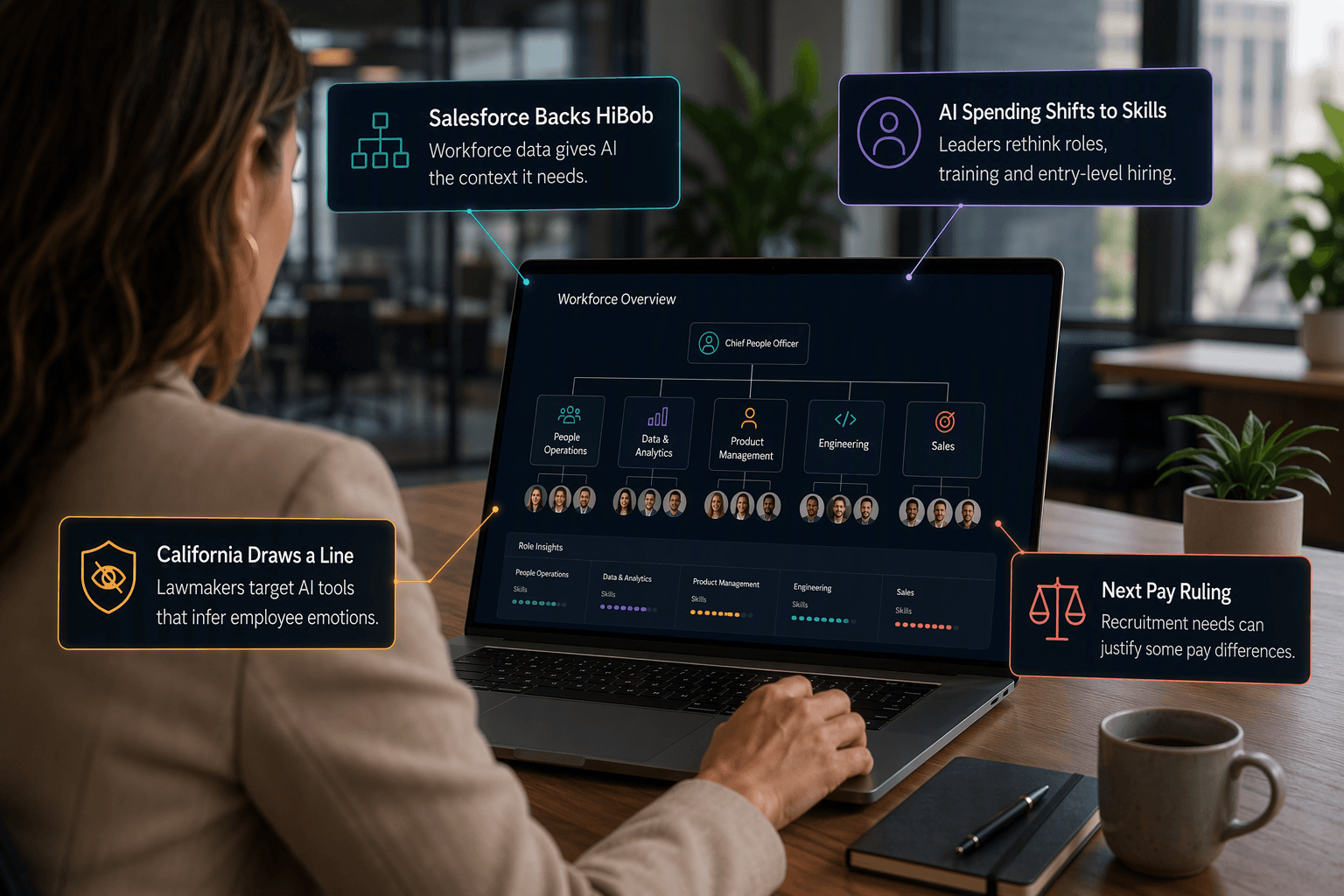
That sequence runs through Salesforce’s investment in HiBob and Accenture’s research into executive AI spending. HiBob is making the case that AI needs a dependable map of an organization before it can be useful, while Accenture’s findings suggest leaders are starting to focus less on the technology alone and more on the roles and skills surrounding it.

The same questions are reaching regulators and the courts. California lawmakers are moving to restrict workplace tools that infer employees’ emotions. But with all this talk of AI, it is important not to forget the basics. A case involving retailer Next has examined when recruitment and retention needs can justify different rates of pay. Together, the stories show how workplace technology is becoming entangled with the basic rules of employment.

Salesforce Investment Backs HiBob’s Workforce Data Push

Salesforce has led an investment in HiBob, with Farallon also participating, as the HR platform provider expands its ambition beyond employee administration. HiBob wants to become an organizational intelligence layer, providing companies with a clearer view of their people, roles, skills, teams, managers, permissions and reporting structures.

The company’s argument is that AI agents and agentic workflows will be unreliable if they lack that context. An AI tool may be able to automate a task or surface an insight, but it cannot make a useful recommendation without understanding who has responsibility, which teams are involved and how the organization is structured. Ronni Zehavi, HiBob’s CEO and Co-founder, said the change AI will bring is not solely a technology story but an “organizational and managerial revolution.”

That premise also explains Salesforce’s interest. Joe Teplow, Slack’s Chief Strategy Officer and an SVP at Salesforce Labs, said HiBob has built a trusted foundation of workforce context and broadened its platform through the acquisitions of Mosaic, an FP&A provider, and UK payroll platform Pento. The strategy is to connect people, payroll and financial planning data, making workforce decisions easier to assess across HR and finance.

Accenture Finds AI Spending Is Shifting Toward Skills

The question of how businesses reorganize around AI is also becoming more prominent in investment decisions. Accenture found that 52% of business leaders would keep investing in AI even if an AI bubble burst, while only 10% believe there is a significant bubble.

The more immediate challenge is getting value from AI through the workforce rather than treating technology spending as an end in itself. Most leaders, 78%, expect workers’ roles to change over the next year. That means companies will need to rethink responsibilities and build skills alongside their technology deployments.
The data also challenges the idea that AI investment necessarily means fewer early-career opportunities. While some companies have linked AI investment to layoffs, 52% of leaders said they plan to hire more entry-level workers to meet AI demand. Another 73% expect to create AI-focused entry-level roles over the next two years.

California Targets AI Tools That Infer Employee Emotions

As employers explore new ways to use AI at work, California lawmakers are attempting to draw a boundary around one of the most sensitive applications. The state legislature approved Assembly Bill 1883 in late August, which would bar employers from using AI-powered workplace surveillance tools that collect “neural data” or recognize or predict a worker’s emotional state. The bill is awaiting action from Governor Gavin Newsom.

The measure defines neural data as information generated through the measurement of activity related to a worker’s central or peripheral nervous system. This can include behavioral signals such as facial expressions and voice characteristics, which emotion-recognition systems claim to interpret. Researchers at the Institute for the Future of Work have stressed that such systems do not understand emotions but process cues as emotional data.

The bill does not prohibit all workplace surveillance and includes exceptions for work conducted for or on behalf of the federal government and technology designed to ensure safety. But its passage reflects a more targeted approach to workplace AI regulation. It follows Newsom’s veto last year of the No Robo Bosses Act, a broader measure that would have restricted employers from relying solely on automated systems for hiring, promotion, discipline or termination decisions.

Next Ruling Gives Employers a Defense for Pay Gaps

The UK Employment Appeal Tribunal has overturned a 2024 ruling in a major equal-pay claim against retailer Next, finding that some pay differences can be justified by recruitment and retention needs. The case involved more than 3,500 retail employees, who argued that pay discrimination contributed to a gap between retail workers, 78% of whom were women, and warehouse workers, 53% of whom were men.

The tribunal concluded that Next was entitled to pay warehouse staff at a higher rate where it had sound business reasons to do so. Justice Bourne said the company paid warehouse workers the rates required for those roles, and that the same considerations did not apply to the retail group. The tribunal did, however, uphold findings that Next had unfairly denied paid rest breaks and overtime pay.

The decision could carry weight as the UK and EU work through gender pay transparency legislation. Similar claims are pending against Asda, Tesco, Sainsbury’s, Morrisons and Co-op. Elizabeth George, a partner at Leigh Day, which represents claimants in such cases, argued that allowing market rates to justify discrimination risks making the same market conditions that create unequal pay a defense for it.

rate this story
helps rank stories across uc today
The discussion0 takes · attributed & checked

Does this reflect your experience?

opening the room…
Read nextordered by techtelligence · every pick explained
picked for this story

Cornerstone Finds HR and IT Need to Coordinate on AI as Employees Struggle to Prepare for Change

13 Aug 2026
picked for this storyCyber Round Up: AI Safety, Agent Risks and Model Security12 Sept 2026picked for this storyBuilding The Smart Workplace: Why Collaboration Technology Is Driving AI ROI17 Jun 2026