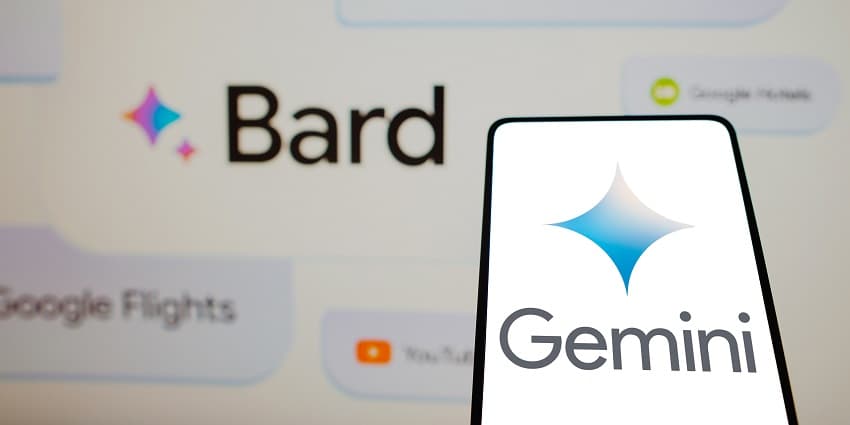
Google Gemini vs. Bard: Is there a difference beyond the change in name? Not long after it officially launched its “Bard” generative AI application, Google revealed it was renaming its popular chatbot, based on the AI model that now powers it, Gemini.
The rebrand doesn’t just change the name of the “Bard” application; it also represents a significant step forward in Google’s generative AI journey. Although you might not immediately notice the difference between using Bard and Gemini (depending on the version you choose), the underlying ecosystem is very different.
You can still chat with Gemini on the web just like you would interact with Bard, and the tool can still generate content and suggestions, similar to Microsoft’s central Copilot solution or ChatGPT. However, Bard is powered by a far more advanced large language model (LLM) ecosystem.
To clarify the chaos, let’s look at the key differences between Google Gemini and the Bard predecessor.
Google Gemini vs Bard: What was Google Bard?
Google Bard was the first Google generative AI app, designed to compete with solutions like ChatGPT and Microsoft’s “Bing Chat” (Now Copilot) service. It was introduced in March 2023, just when the hype around generative AI tools was taking off.
Although Bard did have some initial flaws, it performed relatively well as Google’s initial generative AI bot. It used a lightweight version of the LaMDA model, built on Google’s neural network architecture (Transformer). Interestingly, GPT-3, one of the earlier versions of the models used by OpenAI for ChatGPT, also used the Transformer architecture.
Bard was essentially a chatbot that could help you browse the internet, create content, and summarise long documents or topics. It offered basic writing assistance, content generation options, and fundamental help with SEO (although it couldn’t really help you analyse keywords).
Google Gemini vs Bard: What is Google Gemini?
Google Gemini is both the name of Google’s proprietary collection of large language models (LLMs), and the new name for Google Bard, the company’s previous generative AI chatbot. On a broad scale, the Gemini models (which come in three versions), are multimodal LLMs designed to power a range of Google experiences, including those in Google Workspace, and the Google Gemini web app.
The three Gemini models include:
- Gemini Nano: A “lite” version of the LLM intended for mobile generative AI experiences.
- Gemini Pro: The main version of Gemini, currently powering the free version of the Gemini generative AI chatbot (previously Bard).
- Gemini Ultra: The most advanced version of the Gemini LLM. This version is also available to use with the Gemini chatbot experience via a “Gemini Advanced” subscription plan, which costs $19.99 per month per user.
Initially, there was a waiting list for people who wanted to use Google Gemini instead of Bard. Google opened access to the chatbot experience in 2024 and also introduced new mobile versions of the tool powered by the same underlying LLMs.
Compared to the previous models used to power tools like Bard, Gemini has some unique capabilities. The Gemini LLMs feature advanced reasoning capabilities, according to Google’s CEO. This basically means the bot can “think more carefully” about its answers, reducing the risk of AI hallucinations. It can also understand text, audio, images, video, and computer code.
Perhaps the best way to think of Gemini (at least the chatbot experience) is as the “evolution” of Bard, powered by new large language models and advanced features.
Google Gemini vs Bard: The Core Differences
If you visit the Gemini webpage today, you’ll notice the experience of talking to the chatbot feels similar to using Google Bard. I think Gemini’s interface is a little cleaner, however, and I appreciate all of the “suggestions” you get at the top of the page to help you start using the feature.
When you dive a little deeper, however, the differences between Gemini and Bard become much more notable. Gemini is much more accurate, nuanced, and intuitive than Bard. It was trained on a much larger, more diverse dataset, and it’s better at understanding queries than its predecessor.
It also features one of the longest context windows of any generative AI chatbot, supporting up to 1 million tokens (which is a huge upgrade from what you get with ChatGPT).
If you upgrade to Gemini Advanced, the experience is even better. In fact, Google created a graph comparing the functionality of Gemini Ultra (the LLM that powers Gemini Advanced) to GPT-4. According to the graph, Gemini outperforms GPT-4 in virtually every area.
Google Gemini can also handle more complex tasks that Bard would have struggled with (like intricate creative writing projects). It can access and process information in real time through Google Search and even generate images.
Let’s take a closer look at the key differences between the two tools.
Google Gemini vs Bard: Functionality and Use Cases
Google Gemini isn’t just the name for Google’s updated Bard experience, it’s a comprehensive selection of large language models, powering a range of Google solutions. The chatbot experience offers users comprehensive tools for everything from producing high-quality content to search engine optimisation, image generation, and coding.
With Gemini Advanced, users can access even more advanced functionality. For instance, Gemini Advanced can act like a personal tutor or coach, giving users step-by-step guidance. It can also help build advanced coding scenarios and analyse market trends.