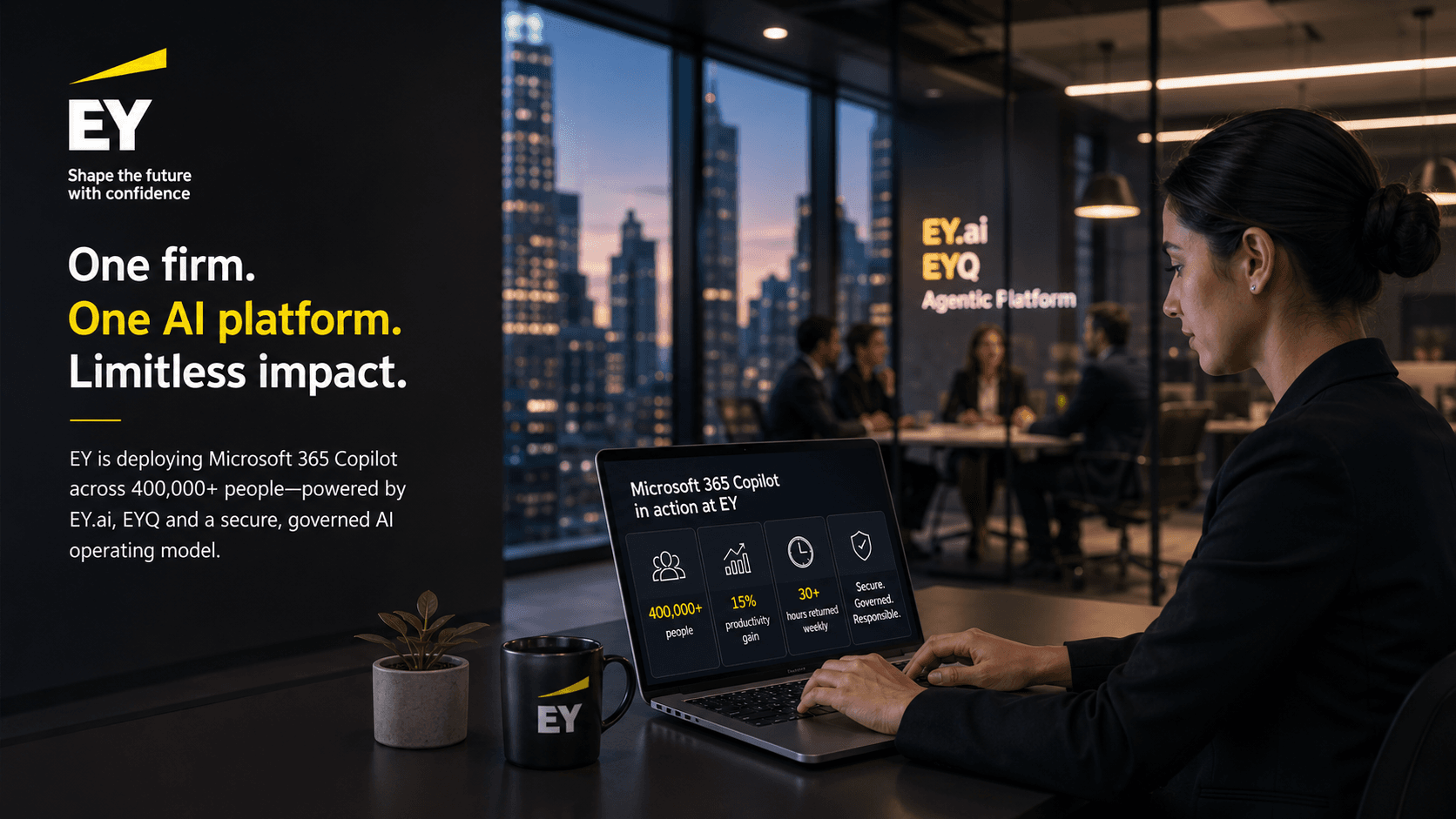
The EY Microsoft Copilot deployment story is impressive because of what came alongside the licenses. EY combined Microsoft 365 Copilot with EY.ai, EYQ, custom workflow automation, security controls and change management across a workforce of more than 400,000 people.
The big lesson from EY’s story is that access to something like Copilot is only one layer of enterprise AI productivity. EY’s latest AI architecture makes that abundantly clear. Microsoft positions Copilot as the front door, while EYQ and the EY.ai Agentic Platform handle agent creation, orchestration, governed data and business-specific automation.
Buyers considering a large rollout need to price and govern the operating model around the assistant, not just the seat.
TL;DR: What Does the EY Microsoft Copilot Deployment Tell Us?
- EY is scaling Microsoft 365 Copilot through E7 across more than 400,000 people, but the operating model also depends on EY.ai, EYQ and custom workflows.
- Microsoft reports a 15% productivity gain, while EY Canada reports 10%; the public methodology behind the larger figure remains incomplete.
- EY’s strongest finance, tax and assurance outcomes required custom automation and connected systems rather than standard Copilot licenses.
- EY’s growing focus on agent economics shows that post-launch cost visibility now belongs in AI governance.
What Is EY Actually Deploying Across Its Workforce?
The EY Microsoft Copilot deployment looks deceptively simple from a distance: 150,000 early users, followed by a scale-out toward more than 400,000 people through Microsoft 365 E7. Get closer and the phrase “Copilot rollout” starts to wobble. EY is running several AI layers, each with its own data, controls, owners and route into live work.
Microsoft 365 Copilot handles familiar employee tasks such as drafting, meeting catch-up, search and analysis. EYQ is the firm’s secure internal AI environment, already used by more than 300,000 professionals.
EY’s 2026 agentic operating-system case study says more than 80% of its professionals use EYQ and that teams developed or explored more than 50,000 agents in nine months. “Explored” still needs care. An agent tested by one team is miles away from a production system with approved data access, monitoring and a retirement plan.
Then come the custom workflows. Finance uses Power Platform, SAP, Dataverse and Copilot Studio. Tax uses Azure AI Document Intelligence. Assurance places multi-agent work inside EY Canvas. EY now describes the EY.ai Agentic Platform as the layer joining intelligence, orchestration, data and governance, with Copilot acting as a front door to that wider environment.
That should make a difference to every enterprise Copilot deployment business case. Licenses create access. Process engineering and agent governance decide whether access changes how work gets done across the business.
Key Takeaways
- Copilot is what employees see and use. It’s only one piece of the wider EY.ai operating model.
- Buyers should separate standard licenses from custom platforms, integrations and agent governance when pricing expected outcomes.
How Did EY Move from Copilot Pilot to Enterprise Deployment?
EY moved from a small Canadian pilot in August 2024 to broader access that October, then reached full deployment across 6,500 licensed users five months after the trial began. The global rollout now scales through Microsoft 365 E7, although EY still hasn’t published a finish date or current active-seat count.
EY Canada split activation into three waves and gave staff 30 to 60 minutes each week to experiment. Hundreds of power users and change champions handled questions, shared working prompts and challenged the inevitable “this thing is useless” reactions. Formal training earned a 21% effectiveness rating. Human-led learning scored three times better than e-learning.
The preparation stretched into identity, access, security, content permissions, job-specific use cases and usage tracking. EY also needed surveys, role-based playbooks and escalation routes after launch. For buyers planning an enterprise Copilot deployment, license assignment is a technical milestone. Repeat usage and a measured workflow result need their own gates.
The resourcing question is valuable too. EY’s global scale-out benefits from Microsoft Forward Deployed Engineers and a five-year, $1 billion-plus joint initiative announced in May 2026. Most customers won’t have either. Buyers should model the people and engineering budget around Copilot before treating EY’s speed as reproducible.
Key Takeaways
- Go-live should include usage and workflow gates beyond license assignment.
- Peer support, protected practice time and job-specific examples need a real budget.
What Productivity Gains Has EY Actually Measured?
EY and Microsoft jointly report a 15% productivity improvement from the initial Copilot rollout. That sounds impressive, but the public evidence doesn’t show the starting point, measurement period, or calculation behind the figure. For now, it’s a reported result rather than one buyers can independently verify.
Microsoft reported in May 2026 that 94% of employees were using Copilot monthly, with 81% saying it saved time and 73% saying their work improved. That’s encouraging adoption data, but buyers shouldn’t mash those figures together. A 94% usage rate proves Copilot got opened. It doesn’t prove 94% of employees became more productive, or that EY converted saved minutes into revenue or better client outcomes.
EY Canada’s 2026 case study reported a lower 10% productivity increase, with heavy users saving up to 3.2 hours each week. That regional result more useful than a simple global average because it shows how enterprise AI productivity changes with job type, usage depth and local support.
HMRC added a tougher benchmark. Its July 2026 evaluation randomly allocated 3,000 licenses, found 83% used Copilot and estimated about 60 minutes saved per employee each week. Analysts reduced self-reported savings by roughly 20% to account for inactive users and response bias. EY hasn’t published an equivalent adjustment.
Key Takeaways
- EY and Microsoft jointly report the 15% productivity gain, but they haven’t published the calculation behind it.
- Buyers should measure capacity, rework and cycle time alongside adoption.
Learn how to measure AI productivity in terms of output, not activity, here.
Which EY Productivity Gains Required Custom Automation Beyond Copilot?
EY’s largest operational gains came from custom workflows built around Microsoft and EY systems. Finance needed SAP-connected Power Platform apps. Tax needed trained document models. Assurance placed agents inside EY Canvas.
PowerPost connects Power Apps to EY’s SAP environment through a prebuilt connector and Microsoft’s data gateway, with Power Automate handling approvals and Dataverse holding workflow data. EY reports 95% faster general-ledger lead times, more than 37% lower operating costs and 120,000 hours saved annually across payment clearing. Its Copilot Studio agent can submit 20 journals in under a minute, down from roughly 15 minutes inside the application.
Tax followed a different route. EY trained Azure AI Document Intelligence models to extract data from forms that can stretch across hundreds of pages. The firm reports up to 90% less manual ingestion work, letting teams begin client work in days instead of weeks or months. That claim covers data entry at the front of the process. Tax judgment still sits with people.
Assurance offers scale rather than a finished ROI figure. EY embedded Azure, Foundry and Fabric agents into EY Canvas, covering 130,000 professionals and 160,000 engagements on a platform processing 1.4 trillion journal-entry lines each year. Full support for every audit activity remains targeted for 2028. Clearly, the best AI productivity use cases with Copilot aren’t always available with an out-of-the-box deployment.
Key Takeaways
- EY’s strongest results required workflow rebuilding, connected records and agent governance.
- Buyers should demand a technology breakdown for every ROI claim.
What Changes After EY.ai and Copilot Go Live at Enterprise Scale?
After go-live, EY has to solve a harder set of problems: data access, agent ownership, variable AI spending and human approval. Microsoft 365 E7 gives EY a shared control layer, while EY’s own platform, routing and cost controls handle issues a Copilot license can’t settle by itself.
E7 went GA on May 1, 2026 at $99 per user each month. That gets buyers Microsoft 365 E5, Copilot, Agent 365, Entra Suite, and a wider set of Defender, Intune, and Purview controls. Agent 365 alone lists at $15 and is designed to help IT keep track of Microsoft and third-party agents. EY’s own bill isn’t public, so the $99 figure is a useful benchmark rather than a peek at what the firm actually pays.
Copilot still follows existing Microsoft 365 permissions. That sounds reassuring until an old SharePoint site has the wrong audience or an employee-built agent reaches data nobody reviewed properly. Serious agent governance needs a named owner for access, testing, incidents, updates and retirement.
EY also tackled model spend with a router for selected tax and risk tools, which it credits with cutting token use by 60%. Its June 2026 Total Cost of Agents framework goes wider, arguing that tokens are only one of seven cost categories. On August 11, 2026, International Accounting Bulletin reported that EY plans to add a Head of Agent Economics role to scrutinize AI spending.
That direction matches a wider buyer problem. KPMG’s June 2026 Global AI Pulse found 42% of leaders had only partial visibility into AI spending and just 7% reported established ROI. Post-launch governance now needs cost owners as well as security owners.
Key Takeaways
- E7 adds controls required once employees start building and using agents.
- Agent ownership should cover spend, permissions, testing and retirement, not security alone.
What Should Other Enterprises Copy From EY’s Client Zero Model?
The repeatable part of EY’s model is its sequencing: controlled pilots, job-specific use cases, adoption support, workflow engineering and formal agent governance. The harder part is the environment around EY Client Zero, where EY tests products internally while Microsoft Forward Deployed Engineers work alongside its own industry teams under a five-year, $1 billion-plus program.
EY also brings technology most buyers won’t receive with a Microsoft 365 E7 agreement. EYQ supports secure internal AI use, while the EY.ai Agentic Platform connects model access, workflow orchestration, governed data and EY business systems. EY says Microsoft and NVIDIA helped co-engineer that environment for more than 400,000 people.
That makes EY a useful execution case and a problematic budget benchmark. A conventional buyer won’t inherit EY’s commercial terms, proprietary platforms or direct engineering access. The 400,000-person rollout shows what’s possible with exceptional resources. It doesn’t tell buyers what a standard deployment will cost or how quickly it will reach the same point.
Before signing, buyers should ask:
- Which outcomes came from standard Copilot?
- Which required custom agents, applications or integrations?
- What does “live” mean in the contract?
- Can the vendor provide a customer reference without Client Zero privileges?
- How will token, agent and orchestration spend be measured after go-live?
EY’s award case is strongest where enterprise AI productivity reaches a measured workflow. The seat count gets attention. The operating discipline earns it.
Key Takeaways
- Copy EY’s rollout method, then price it against the resources your business actually has.
- Treat Client Zero evidence as a high-end reference case, not a standard delivery promise.
What Are the Lessons From the EY Microsoft Copilot Deployment?
EY has built one of the clearest public examples of firm-scale AI productivity moving from employee access into governed business execution. Its strongest evidence comes from connecting Microsoft Copilot change management with custom workflow design, EY.ai infrastructure and formal agent governance.
The gaps don’t disappear, though. EY and Microsoft haven’t published the full method behind the 15% productivity claim, the global rollout remains in progress, and a standard E7 customer won’t receive EY’s proprietary platforms or Client Zero engineering support.
EY’s advantage in productivity and automation isn’t the size of the Copilot deployment itself, it’s the operating system around what gets automated, who owns it, how costs are controlled and which outcomes are actually measured.
FAQs
Is EY's global Microsoft 365 Copilot rollout complete?
No. The EY 400,000-person Copilot rollout is still being expanded across the firm. EY has confirmed the direction and the initial deployment population, but it hasn't published a final completion date, active-user total or country-by-country schedule. Buyers should read “scaling” literally rather than assuming every employee already has the same license, access and usage level.
Is EY's AI model router part of Microsoft 365 Copilot?
No. EY's model router sits behind selected tax and risk tools and chooses an appropriate model for each request. It doesn't manage the general employee Copilot chatbot. That boundary matters because the reported token reduction applies to those routed workloads, not the entire EY Microsoft Copilot deployment.
Does Microsoft 365 E7 include Agent 365?
Yes. The Microsoft 365 E7 Frontier Suite combines Microsoft 365 E5, Copilot, Agent 365 and additional identity, security and data controls. Agent 365 handles discovery, access and oversight for Microsoft and third-party agents. Buyers can also purchase it separately, which makes license segmentation worth discussing before assigning the full bundle across an entire workforce.
Are EY's finance and tax outcomes available through standard Copilot licenses?
No. EY's finance results depended on Power Platform, SAP connectivity, Dataverse, Power Automate and Copilot Studio. Its tax work used Azure AI Document Intelligence trained for complex forms. A standard Copilot license provides the employee assistant layer. Reproducing those outcomes requires process redesign, connected data and agent governance around the finished workflow.
No. EY.ai Agentic Platform is EY's own technology environment, designed to connect model access, orchestration, governed data and EY business systems. Microsoft 365 E7 supplies Microsoft's Copilot, Agent 365, identity, security and compliance layer. Buyers shouldn't assume an E7 agreement reproduces EY's proprietary platform or Client Zero engineering support.