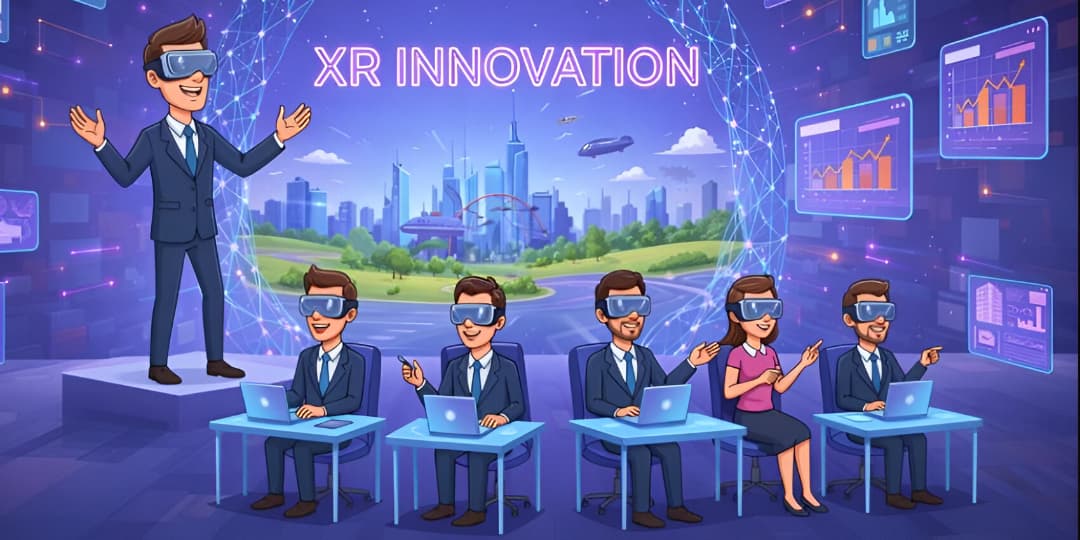
Immersive workplace and XR is moving out of the hype cycle and into day-to-day operations. Once dominated by consumer gaming and flashy demos, extended reality (XR)—an umbrella term covering virtual reality (VR), augmented reality (AR), and mixed reality (MR)—is now being adopted by enterprises that need to train faster, work safer, and collaborate smarter. In 2026, workplace XR isn’t a “nice to have”. Instead, it’s becoming a practical layer in the digital workplace stack.
Discover the latest XR trends for 2026
However, enterprise XR adoption still comes with friction. ROI can be unclear, hardware and software ecosystems can feel fragmented, and scalability can get messy fast. On top of that, change management matters: employees may be unfamiliar with immersive tools, IT teams worry about endpoint security and device management, and buyers are rightly cautious about lock-in or aging hardware. As a result, many XR pilots stall before they reach real deployment.
Navigation:
- What is Extended Reality?
- The Business Case: Is XR Worth It?
- Implementing XR into Your Business
- Long-term XR Business Success
Content creation is another hurdle. High-quality, job-specific XR experiences take time, expertise, and budget. Therefore, without a clear use case and a measurable success definition, XR risks becoming an expensive experiment rather than a performance tool.
Even so, the enterprise XR landscape has matured quickly. What began as a B2C-led market has shifted toward B2B value—especially in training, simulation, and frontline enablement. In practice, healthcare teams use XR for surgical training and therapy. Meanwhile, logistics and manufacturing teams deploy AR for pick-by-vision, maintenance, and safety workflows. Similarly, construction, energy, and field services use XR to reduce errors and keep workers out of harm’s way. Finally, some knowledge workers now use immersive collaboration for complex 3D work where 2D meetings fall short.
So, for enterprise buyers, the question is no longer “What is XR?” It’s “Where does XR add measurable value—and can it be governed like the rest of the UC and workplace stack?” This guide cuts through the noise and grounds XR adoption in business reality.
Discover:
- Enterprise XR: Pain Points and Solutions
- VR vs AR vs MR: Which is Best for Your Business?
- Step-by-Step: How to Integrate XR into Your Business
- What Can the XR Market Promise Before 2030?
Why Adopting XR is Crucial
Extended reality for business is no longer “emerging” in the way it was a few years ago. In 2026, XR is increasingly treated as a workforce and operations capability that can drive measurable value across training, frontline execution, and enterprise collaboration.
What’s changed is how enterprises evaluate it. Instead of judging XR by immersion or novelty, leaders compare it to enterprise benchmarks: security, interoperability, lifecycle management, and ROI. Consequently, XR now fits the UC Today mission: helping IT and business leaders build productive workplaces where technology removes barriers and improves performance.
For CIOs, COOs, Heads of Learning, and digital workplace leaders, the question has shifted decisively. It is no longer whether XR works. Rather, it’s where it fits, how it scales, and what outcomes it delivers.
Still Not Convinced?
Enterprise adopters of XR are building more adaptable workplaces. Explore what you need to know to evaluate XR with confidence.
Explore UC Today for updates on immersive workplace and XR technology.
What is Extended Reality?
What is Extended Reality and How is it Used in 2026?
XR includes several distinct technologies, each serving different business needs. VR places users inside a fully digital environment, which makes it ideal for training, simulation, and scenario-based learning where safety, cost, or disruption is a concern. AR overlays digital information (instructions, data, visuals) onto the real world—often via smartphones or headsets—so workers can complete tasks faster and with fewer errors. MR goes a step further by anchoring interactive digital objects into physical space for spatial workflows, design reviews, and collaborative planning. Finally, assisted reality focuses on hands-free guidance and remote expert support, typically via lightweight smart glasses for frontline teams.
In 2026, XR is increasingly embedded in enterprise operations. For example, companies use VR to onboard employees, rehearse complex procedures, and assess competency at scale. Meanwhile, AR and assisted reality support technicians with step-by-step guidance, reducing downtime and rework. MR is also growing for digital twins and distributed problem-solving. Crucially, XR delivers more value when it integrates with enterprise systems such as learning platforms, asset management tools, and analytics—making it part of the core stack rather than a standalone tool.
UK market signal: PwC’s analysis of UK XR usage identified 1,550 unique examples of business XR usage, with 66% of organisations using VR (vs AR) and engineering/manufacturing leading adoption. Read: PwC – The business benefits of XR are real and all around us.
Enterprise XR: Pain Points and Solutions
Enterprise XR exists to fix problems traditional tools struggle with: slow training, inconsistent performance, safety risks, and rising operational costs. At its core, XR helps people learn faster, make fewer mistakes, and perform better in real conditions. That’s why adoption is scaling beyond pilots.
One of the biggest pain points XR solves is workforce training. VR platforms like Meta Quest for Business and Varjo enable repeatable training for high-risk or complex tasks, without shutting down operations or putting people in danger. As a result, employees can practise procedures and safety scenarios until they’re competent—improving onboarding consistency and lowering incidents.
On the operational side, AR and assisted reality tools reduce errors and downtime. Solutions like PTC Vuforia and TeamViewer Frontline provide step-by-step guidance for technicians in their field of view. Therefore, instead of relying on manuals or calling for help, workers get real-time instruction or remote expert support—driving faster task completion and more consistent outcomes.
Enterprise XR is fundamentally different from B2C XR. Consumer XR optimises for entertainment. In contrast, enterprise XR is designed for reliability, scale, and measurable outcomes. Devices like Microsoft HoloLens 2 prioritise durability, security, device management, and integration with enterprise systems. Content is purpose-built around workflows, KPIs, and compliance.
In short, enterprise XR isn’t about wow factor. It’s about solving practical problems, improving performance, and delivering results that show up in productivity, safety, and operational efficiency.
View the latest UC Today reports on XR here.
The Business Case: Is XR Worth It?
VR vs AR vs MR: Which is Best for Your Business?
Choosing between VR, AR, and MR depends on the business problem you’re solving—not the technology trend. Start with outcomes (training speed, error reduction, downtime reduction, design-cycle time), then map the right modality.
Virtual reality (VR) creates a fully immersive digital environment that blocks out the physical world. This makes it ideal for training, simulations, and behavioural learning where real-world risk or distraction is a problem. However, VR’s limitation is isolation, so it’s not designed for live work or extended daily use.
Best for: safety training, high-risk simulations, soft-skills development.
Augmented reality (AR) overlays digital instructions and data onto the real world. It helps workers complete tasks faster and with fewer errors without removing them from their environment. Consequently, AR is widely used in logistics, warehousing, field service, and maintenance to guide workflows in real time. Still, it’s not suited to deep simulation or complex spatial modelling.
Best for: frontline task guidance, inspections, maintenance, logistics.
Mixed reality (MR) anchors interactive 3D models into real spaces. Therefore, teams can collaborate with digital twins, visualise designs at scale, and work together remotely. The trade-off is higher cost and deployment complexity versus AR.