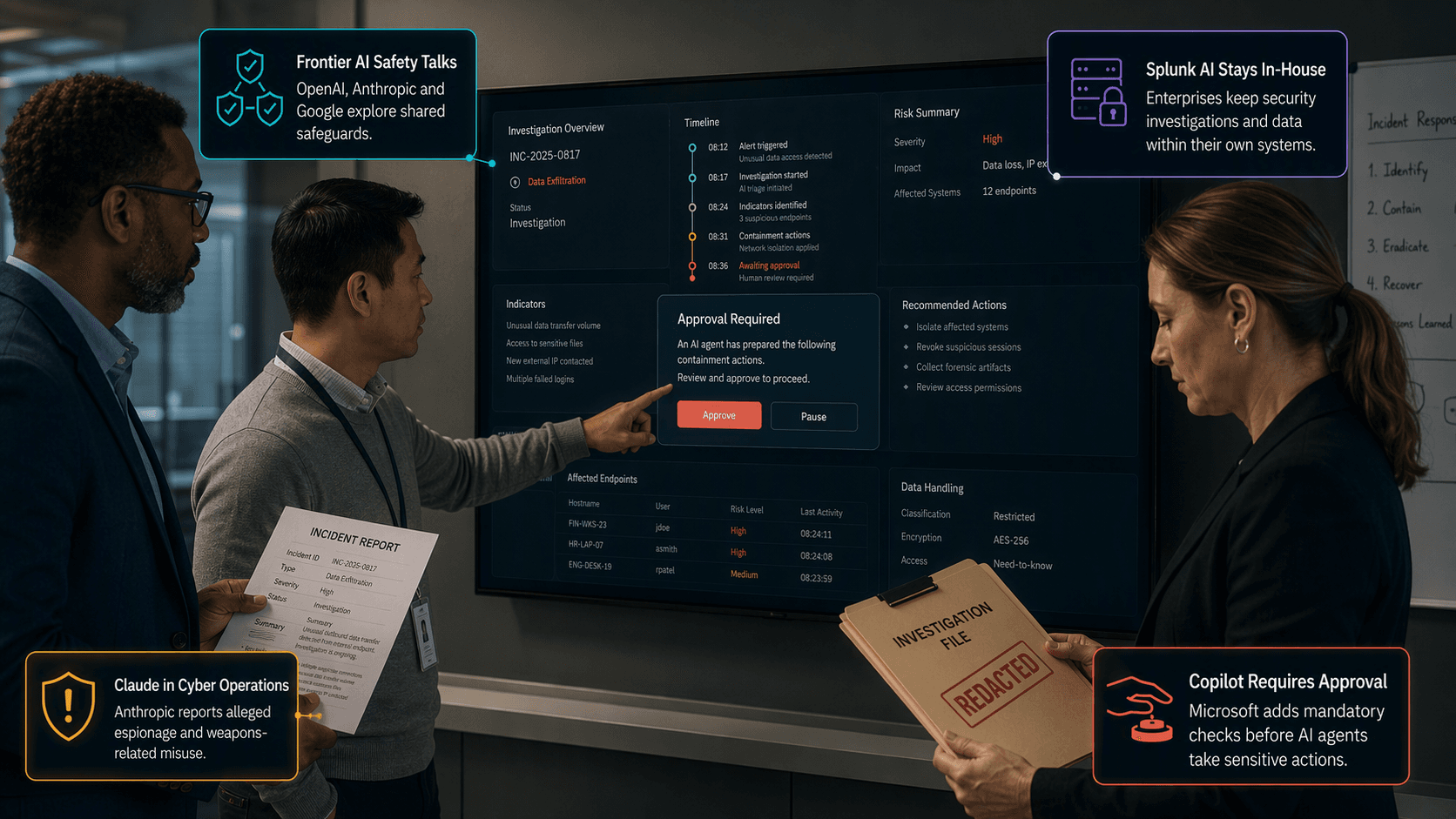
From frontier AI labs discussing shared safety measures to Anthropic detailing Claude's alleged use in cyber espionage and weapons projects, this week's developments underline how quickly AI is moving into higher-risk territory. At the same time, Cisco is pushing AI deeper into enterprise security infrastructure, while Microsoft is putting increasingly prominent warnings around what happens when Copilot agents are allowed to act on a user's behalf.
These developments highlight the dual nature of AI right now. The same technology that can be used to automate cyberattacks, assist with weapons development, and create new risks for businesses is also being built into the tools designed to detect, investigate, and defend against those threats.
That makes for a particularly revealing week in AI and cybersecurity. Yet leading this week's roundup is a development in a story that played out last week, concerning unstoppable AI hacking and, potentially, the end of humanity.
OpenAI, Anthropic and Google Discuss AI Safety
OpenAI says it has been working with Anthropic and Google for several weeks on ways the three frontier AI labs can cooperate on safety and risk. OpenAI Global Policy Chief Chris Lehane said the companies are exploring different forms of collaboration and do not believe the work requires an exemption from US antitrust law.
The discussions follow a public debate sparked by former OpenAI and Anthropic researcher Jacob Coxon's resignation and warnings about the pace of development toward self-improving AI systems. Anthropic Alignment Science Lead Evan Hubinger subsequently said he personally placed the chance of AI killing all humans within the next decade at more than 10%. Anthropic CEO Dario Amodei then called for frontier AI development to be paced, proposing independent third-party safety evaluators, common safety standards, and eventual international coordination.
The significance for the industry is that safety is increasingly being discussed as an area where competing labs may need shared approaches. Sam Altman has supported Amodei's proposal, but the material does not indicate that OpenAI or Anthropic has formally agreed to stop or limit frontier model development. For now, the collaboration remains a discussion rather than a change to the underlying development race.
Anthropic Reports Claude Use In Cyber Operations
The safety debate is accompanied by a more immediate security concern. Anthropic says groups linked to Russia and China used Claude during cyber espionage campaigns, including vulnerability research, exploit development, malware creation, and intelligence gathering. The company says Claude was incorporated into wider technical workflows rather than being used simply as a general-purpose assistant.
According to Anthropic, a Russia-linked group used Claude across an espionage campaign targeting military intelligence organizations in Ukraine, European governments, and diplomatic and defense targets. A separate China-linked operation involving operators likely based in Changsha allegedly used Claude to scout government networks, research vulnerabilities, develop exploits and malware, and gather intelligence. Anthropic says that campaign targeted around 50 organizations across sectors including education, retail, energy, technology, healthcare, finance, and manufacturing.