Enterprise XR has often been framed as a hardware-adoption problem. Can workers tolerate the device? Does it improve safety or productivity? Can it be deployed cheaply enough to justify the effort?
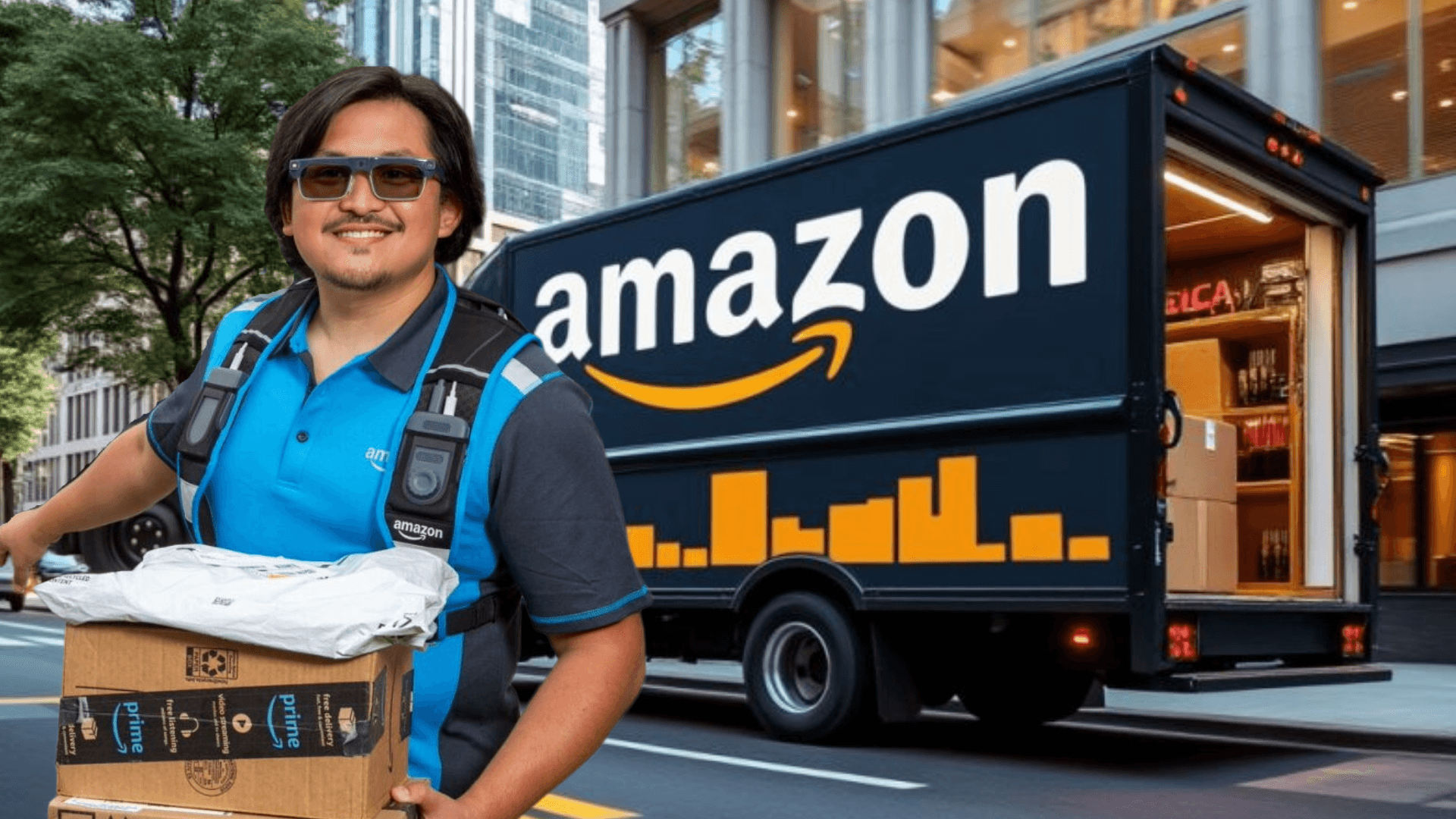
Amazon’s latest delivery-driver rollout suggests those questions are no longer theoretical. The company says more than 500 delivery associates have used its smart glasses across more than 275,000 deliveries, with 5,000 additional devices planned for deployment this year and more than 20,000 targeted by the end of 2027. The system is designed for a repeatable frontline workflow: identifying packages, navigating to the doorstep, capturing proof of delivery and flagging hazards.
But as the rollout scales, the more consequential question may be what happens to the data created while workers use the glasses. Reporting this week indicates that the devices may capture several thousand images during a typical driver shift, creating a significant governance challenge involving workers, customers, bystanders and private property.
TL;DR
Amazon’s smart glasses are a material frontline deployment, not a consumer-device experiment.
The operational case is clear: a contextual, hands-free interface can remove repeated phone, scanning, navigation and photo-capture interruptions from delivery work.
The harder enterprise test is governance: organisations need clear rules for visual-data capture, processing, access, retention, deletion and worker protection before scaling camera-equipped wearables.
Why Does Amazon’s Rollout Matter for Enterprise XR?
Amazon’s delivery glasses matter because they are embedded in work rather than added beside it. The wearable uses a heads-up display (HUD), a display that presents information in the user’s field of view, to provide navigation and delivery instructions. Amazon says the glasses can help associates locate and scan packages, provide walking directions, identify potential hazards and pets, capture proof of delivery, and alert a worker when a package may have been left at the wrong address.
That makes the technology a case study in the practical value proposition for immersive workplace tools. Rather than asking a worker to switch between a phone, a scanner, a map and a camera, the device attempts to bring those micro-interactions into one contextual interface.
Amazon says the glasses have a hardware privacy switch and that their use is voluntary for Delivery Service Partner (DSP) owners and delivery associates. Kaleb M., a delivery associate in Omaha who tested the technology, said: “I felt safer the whole time because the glasses have the info right in my field of view. Instead of having to look down at a phone, you can keep your eyes forward and look past the display—you’re always focused on what’s ahead.”
Those are Amazon’s own deployment claims and user testimony, rather than independent safety or productivity findings. The company has not published comparative data showing whether the glasses reduce delivery times, mistakes or accidents at scale. Still, the scope of the planned rollout means the industry should treat it as an operational deployment with implications beyond Amazon’s logistics network.
What Is Frontline XR?
Frontline XR describes extended-reality tools used by employees doing physical, mobile or site-based work. In practice, it can include smart glasses, augmented-reality overlays, immersive training and remote-assistance systems. The commercial objective is usually to put relevant information into the flow of work while reducing the need to stop, look down or switch devices.
What Changes When Smart Glasses Become a Visual-Data System?
The most important detail in the current debate is not that the glasses have cameras. Cameras are already common in enterprise settings, from delivery proof-of-completion images to vehicle systems and body-worn devices. It is the frequency, context and scale of capture that change the governance equation.
The Verge reported that the glasses can take pictures “almost constantly,” potentially producing several thousand captures in a typical shift and uploading them to Amazon’s Wellspring artificial intelligence (AI) platform. The report says these images may include people and private property encountered during a route.
Amazon’s Viraj Chatterjee told the publication that systems blur people and licence plates before images are passed to human reviewers. That is a meaningful technical control, but it does not settle the broader governance question. Blurring does not by itself clarify what is retained, who may access the original or processed image, what purpose justifies human review, or how a person can challenge inappropriate collection.
The Verge also reported that Amazon had not specified a retention period, a route for customers to view or request deletion of images of themselves or their property, or a customer opt-out. Chatterjee reportedly said, “We haven’t thought about that,” when asked about an opt-out. Amazon also confirmed to the publication that images could be obtained with a warrant.
These points should be treated carefully. They describe the policy gaps reported at a particular time, not proof that Amazon cannot or will not establish further controls as its rollout expands. However, the absence of publicly articulated rules is itself relevant for enterprise buyers. Once a system makes continuous visual capture operationally normal, governance cannot remain an implementation detail.
Why Now?
Smart-glasses deployments are shifting from demonstrations and small pilots to recurring operational workflows.
AI-assisted vision systems increase the volume and potential reuse of images generated during everyday work.
Privacy controls need to cover not only employees wearing the device, but also customers, visitors, bystanders and the private spaces visible during work.
Where Should Human Oversight Begin and End?
Human review is not automatically incompatible with responsible deployment. Organisations may need it to validate delivery exceptions, investigate safety incidents or assess whether an automated system made the right recommendation. The issue is whether the scope of review is proportionate, documented and limited to a defined business purpose.
For Amazon, there is also a workforce dimension. Delivery associates may benefit from fewer device switches and more immediate safety information, but the same stream of visual data could potentially become a source of performance monitoring. A policy that is framed only around customer privacy will miss a central enterprise risk: whether workers know what is captured, when it is reviewed, how long it is retained and whether it is used in management decisions.
That distinction matters because frontline systems are typically introduced into unequal employment relationships. “Voluntary” use may be meaningful only if workers and delivery partners can decline without losing access to preferred routes, income or advancement. Amazon’s statement that participation is voluntary is therefore an important starting point, but not a complete governance framework.
Buyers should also avoid assuming that controls available on one device category translate directly to another. As The XR Beat notes, camera and microphone deployments require explicit policies for consent, storage, retention and access. Smart glasses can also introduce operational complexity around paired phones, accounts, Bluetooth connections, updates, charging, cleaning, prescription needs and resetting captured data between users.