What are smart glasses?
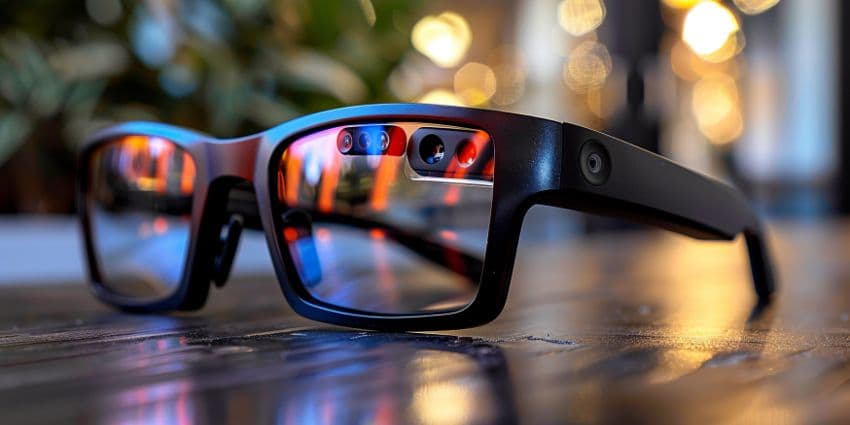
You might think you already know the answer – but these days, it’s actually more complicated than it seems. Some people define smart glasses as any pair of “specs” with built-in technology, like digital displays, computer chips, cameras, and microphones.
Others, like Meta, with their Ray-Ban glasses and Frame AI, advertise smart glasses as specs with built-in artificial intelligence assistants (among other features). Then, we have perhaps the most exciting form of smart glasses available today: augmented reality glasses.
If you’re confused, you’re not alone. That’s why we’ve created this guide to help you understand the different types of smart glasses, how they work, and how they’re revolutionizing the world of wearable technology.
What are Smart Glasses? The Basics
Ultimately, there’s no one-size-fits-all answer to “What are smart glasses?” On a broad scale, they really are just spectacles that feature technology, but what kind of tech is embedded into these wearable devices will differ depending on who you ask.
If you check out the latest reviews and lists promoting smart glasses on the web today, you’ll likely find a selection of options that fall into specific categories. Here are the main categories you should be able to explore if you’re investing in wearable tech:
- Smart glasses that work as a smartphone accessory
- Smart glasses that enable access to AI assistants
- Smart glasses with a heads-up display
- Smart glasses with virtual screens
- True AR smart glasses
Phone Accessory Glasses
Let’s start with the glasses that some people might not define as smart glasses at all. These are specs like the initial Ray-Ban Stories, which featured a set of cameras, an app you could access on your phone to share photos with friends, and speakers for listening to music. Since the glasses were also connected to your phone, you could take phone calls using them.
Obviously, Ray-Ban and Meta later partnered on a new set of smart glasses that are a lot more advanced, with onboard AI, but the first set of specs were much simpler. Another example might be the early versions of the “Snap Spectacles” – the specs that didn’t include any AR features.
Basically, these specs are just smartphone accessories or tools intended to enhance your experiences with social media apps on the move. They might allow you to take pictures or even answer phone calls, but they’re not going to give you any kind of “immersive” experience.
What are Smart Glasses? AI Specs
Next, we have glasses with integrated artificial intelligence capabilities. In our opinion, including AI is one of the first things that starts to turn “tech specs” into “smart glasses.” Many early-stage AI glasses, like the Amazon Echo Frames, don’t actually have a display built into them. For instance, you won’t be able to view any images overlaid into your real-world environment with AR.
However, you can interact with your glasses using built-in microphones. This means you can speak to an assistant that can load music from your smartphone to play through your speakers, start a call for you, or even search the web for information.
The Ray Ban Meta glasses are the most obvious example of this type of “smart glasses” technology in action. These specs have become extremely popular in the last few years, particularly for tech enthusiasts who want a “fashionable” pair of specs that feel ultra-futuristic. However, the smart experience is still very limited.
Smart Glasses with Heads-Up Displays
Here’s where we start to bring “augmented reality” experiences into smart glasses – at least on a basic level. Although smart glasses with a heads-up display don’t actually “augment” reality, using things like spatial mapping capabilities, they do project images in front of your vision.
Usually, these specs leverage waveguide technology, to reflect information from a connected device, like your phone or your laptop, onto the world in front of you. They’re basically heads-up displays that are intended mostly for enterprise use cases. For instance, you’re probably familiar with options like the Vuzix Shield safety glasses, for industrial and frontline workers.
Glasses like these can help boost productivity and performance in various settings, giving users access to instant hands-free information, such as data about a machine’s performance. However, they lack the advanced spatial capabilities of modern XR solutions and generally don’t give you much control over your display settings.
Smart Glasses with Virtual Screens
Smart glasses with virtual screens might seem similar to specs with heads-up displays, but they’re a little different. While the options with heads-up displays are usually intended for enterprise use cases, smart glasses with virtual screens are more focused on the consumer market.
Products like the Rokid Max give users access to huge, configurable virtual screens that are perfect for watching videos or playing games. They also feature slightly more advanced technology, such as prisms, to redirect the light that comes from the top of the glasses instead of waveguides.
Although this makes the glasses' frames a little thicker, it does mean you end up with a more “immersive” experience, closer to genuine augmented reality. However, it’s worth noting that these specs generally don’t include their own computer chips. They usually rely on a companion system to run applications, such as your phone or something like the XReal Beam or Rokid Station.
On the plus side, this means you usually end up with a more lightweight wearable device than an MR/AR headset or virtual reality headset.