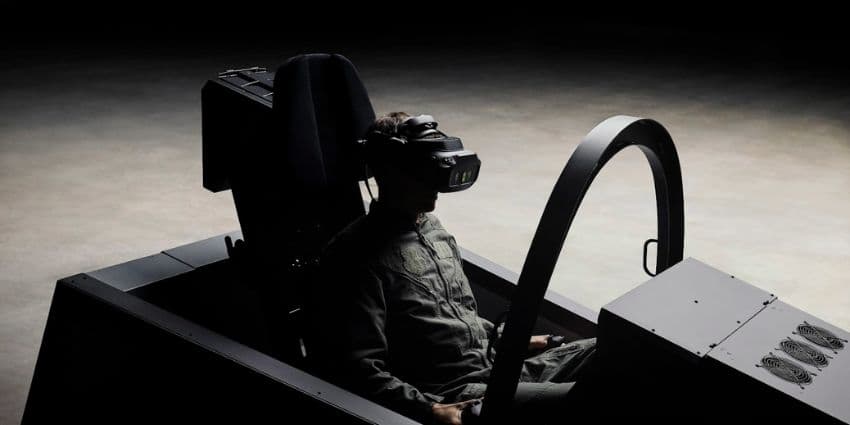
At a training facility in Finland, pilots sit inside full-scale cockpit replicas while wearing XR headsets that overlay a fully simulated environment beyond the physical frame.
The switches, dials, and controls are real, but everything outside the cockpit window is virtual – from weather systems to terrain and other aircraft.
The result is a hybrid training environment that blends physical hardware with digital simulation, allowing trainees to rehearse complex scenarios repeatedly and safely.
For Varjo, the Finnish company behind the headsets used in these environments, this is where XR is finding its most immediate and practical uses.
“Enterprise XR adoption is fragmented, but training – particularly in the military – is where we see real traction,” says Patrick Wyatt, Varjo’s Product Officer.
Moving from Consumer Hype to Industrial Use Case
Extended reality, which includes virtual reality and mixed reality systems, has long been associated with consumer gaming and enterprise collaboration experiments.
But over the past few years, its most consistent adoption has come from training-heavy industries – particularly aviation, defence, and emergency response.
This shift mirrors broader industry patterns.
Companies like Microsoft, through its HoloLens programme, have focused heavily on defence and industrial applications, including battlefield awareness systems and maintenance training.
Meanwhile headset makers such as HTC have targeted enterprise simulation environments, including manufacturing training and aerospace and aviation simulation use cases within broader XR training systems.
But it is defence simulation – historically dominated by large physical simulator domes costing tens of millions of dollars – where XR is increasingly being positioned as a lower-cost alternative.
Traditional full-flight simulators used in aviation training can cost upwards of $10–20 million per unit, require dedicated facilities, and are limited in how quickly scenarios can be modified.
XR systems aim to reduce both cost and complexity by shifting much of that simulation into software.
Inside Varjo’s Approach to Mixed Reality Training
Varjo’s systems sit at the high-end of the XR market, designed specifically for industrial and defence applications rather than consumer use.
In practice, their headsets are used to merge real-world physical environments – such as cockpits – with simulated external visuals rendered in real time. The aim is not just immersion, but fidelity: ensuring that what pilots see closely matches what they would experience in real-world conditions.
“The most advanced customers are creating complex blends of real and virtual environments,” Wyatt explains.
“They might have different systems rendering different parts of the scene, while our headset integrates those elements and tracks the user’s hands.”
This blending of physical and virtual inputs allows training programmes to simulate everything from basic flight procedures to emergency scenarios that would be too dangerous or expensive to replicate in live environments.
Defence as the Primary Growth Market
The company's technology is primarily deployed in defence contexts, particularly among NATO-aligned countries. According to Wyatt, this includes programmes within the US Army and US Air Force, alongside European defence organisations.
One such example is the US Army’s Reconfigurable Virtual Collective Trainer, which is used for helicopter simulation training across platforms such as Black Hawks, Apaches, and Chinooks.
While XR in defence is not new, its role is expanding as militaries look to reduce costs, increase training frequency, and improve data capture during exercises.
“You can track things like eye movement and reaction times during a session,” Wyatt says. “That gives you data you wouldn’t typically get from a conventional simulator.”
This reflects a broader trend in defence technology – the shift from purely physical training systems to data-rich digital environments that allow for more granular performance analysis.
The Broader Defence Simulation Ecosystem
XR training is ultimately part of a wider ecosystem that includes simulation integrators, defence contractors, and government programmes.
Large defence firms such as Lockheed Martin and Boeing have long developed simulation environments for pilot training and mission rehearsal. Traditionally, these systems have relied on large-scale physical simulators or desktop-based virtual environments.