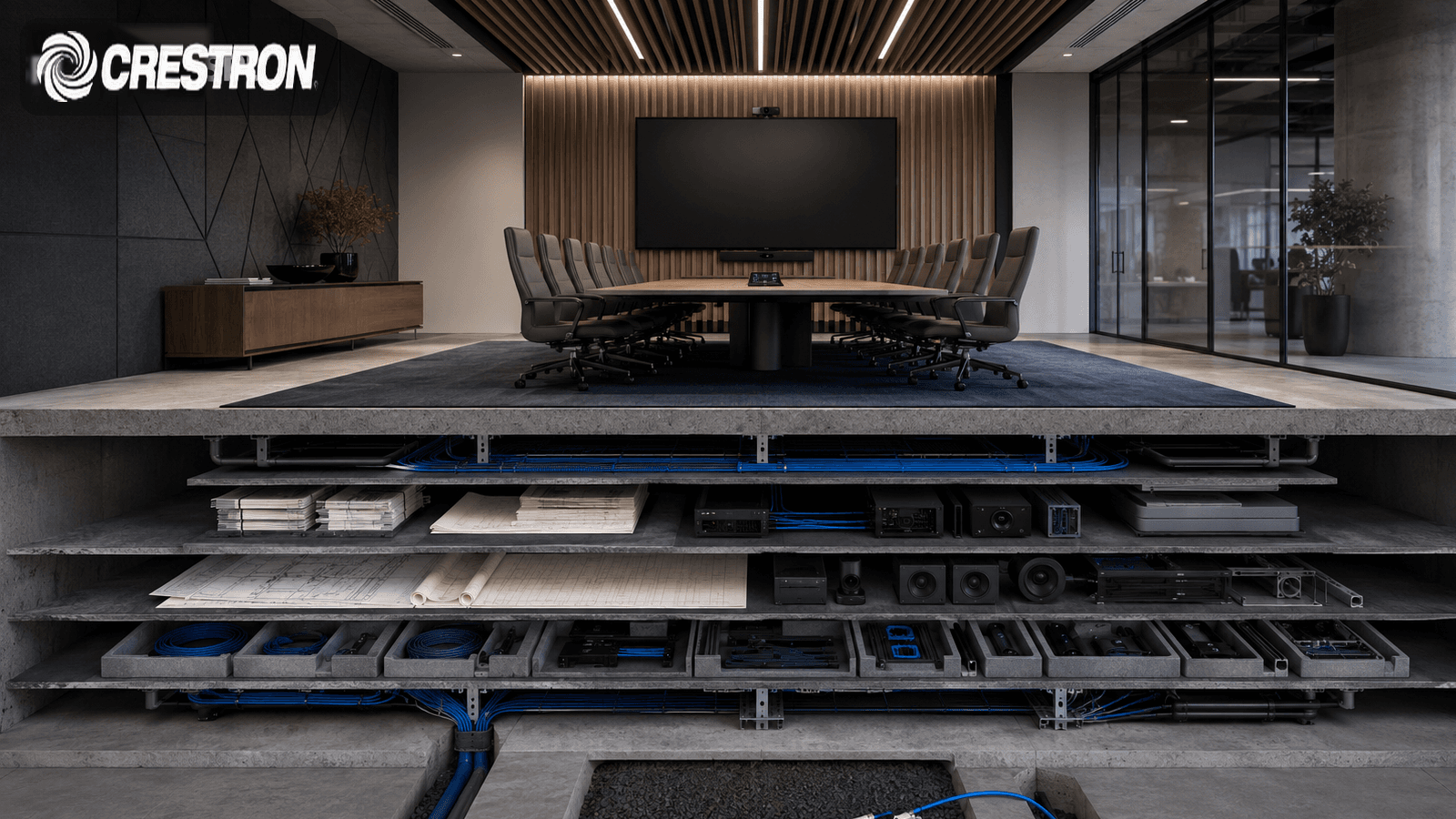
Crestron is moving Flex toward a modular room architecture built around Collab Compute, intelligent AV, 80 Series control, and XiO Cloud. The strongest evidence is around deployment, standardization, and fleet management; buyers still need harder proof that the new stack reduces meeting failures and lifecycle cost.
Meeting problems are stacking up. Jabra’s June 9, 2026 Cost of Bad Meetings Report found that 75% of meetings now suffer at least one technology failure. When something breaks, the room loses about 11 minutes. Eleven dead minutes in a room full of executives, customers, or project leads is a business cost with a calendar attached.
So Crestron has picked an interesting moment to rebuild Flex. The 2026 Crestron Flex roadmap puts Crestron Collab Compute, AutoMeasure, DM NAX, the i12D camera, 80 Series touchscreens, and XiO Cloud under one room architecture. Crestron calls it Deploy-Core-Peripheral.
The company is putting serious effort into meeting room standardization, automated AV deployment, and meeting room device management. That makes sense. AI-ready meeting rooms with flaky audio, awkward controls, or unreliable BYOD conferencing are bad rooms with more expensive processors. So, will the roadmap pay off?
TL;DR: Is Crestron’s Flex Roadmap Ahead of the Meeting Room Problem?
- The roadmap shift: Crestron is moving from fixed Flex kits toward a component-led architecture built around Collab Compute, with July 2026 end-of-sale notices naming CCC-110 and CCC-120 models as replacement paths for several legacy kits.
- What has shipped: Collab Compute hardware, AutoMeasure for Automate VX2, DM NAX AP-100 ceiling audio, the i12D camera, 80 Series touchscreens, and five XiO Cloud releases between February and July 17, 2026.
- What still needs checking: Direct USB-C BYOD conferencing through the TS-1080-UC/TSW-1080-UC remains marked “Coming Soon” in current Crestron documentation, and tabletop DM NAX Audio Pods are also still pending.
- The buyer test: Crestron has a stronger case for standardization, commissioning, control, and management than for meeting outcomes. Buyers should ask for failed-start rates, join time, remote-fix rates, migration costs, and five-year TCO.
What Do Enterprise Buyers Need From Meeting Room Technology in 2026?
Enterprise buyers need smart meeting rooms that work the first time and behave predictably when an outside guest brings a different platform. They also need evidence when something fails. A meeting room should be easier than opening a laptop at a desk. If people enter already expecting cable trouble, the specification has failed.
FORTÉ’s March 25, 2026, 2026 survey of 512 IT decision-makers showed reliability ranking as the biggest concern for teams. 47% cited remote-joining problems and 41% poor audio or video. The same 2026 research found 85% of organizations expect collaboration and meeting-room budgets to increase over the next one to three years. Reliability still has to earn that investment.
Hybrid meeting equity is even more problematic. Lucid’s 2025 hybrid-work survey found that 39% of organizations had equipped rooms for remote and office participants. Training reached 37%, and formal meeting rules reached 34%. A camera can frame the remote attendee beautifully while everyone in the room still talks over them.
Then there’s the space planning problem. JLL’s May 2026 Global Occupancy Planning Benchmark Report tracked 84 organizations managing 716 million square feet and found office utilization at 56%. Copying the same kit into every room wouldn’t work for long. Buyers need room designs based on actual behavior, platform use, support history, and who joins from elsewhere.
Key Takeaways
- Reliability is still the first buying test. New AI features matter less if rooms continue to waste time at join and recovery.
- Standardization should follow room behavior, platform mix, support history, and occupancy data rather than copying one design everywhere.
What Is Crestron’s Deploy-Core-Peripheral Strategy?
Deploy-Core-Peripheral isn’t replacing Crestron Flex. It’s reshaping how Crestron builds and scales Flex rooms. Instead of relying as heavily on fixed room kits, Crestron is moving toward a modular architecture in which Collab Compute provides the core, deployment tools standardize installation, and cameras, audio, touchscreens, control, and scheduling can be selected around the room.
Crestron’s Deploy-Core-Peripheral strategy splits the room into three jobs: install it consistently, give it a common compute and management base, then simplify the devices people touch and hear. For enterprise buyers, the promise is fewer bespoke rooms and less guesswork when hundreds of spaces need the same behavior.
| Layer | What It Covers | Status as of July 2026 | Buyer implication |
|---|---|---|---|
| Deploy | AutoMeasure, PoE hardware, device discovery, validated room designs | Live, but AutoMeasure only works with Automate VX2 running version 6.5+ | Live, but limited to VX2 and supported peripherals. |
| Core | Crestron Collab Compute, XiO Cloud | Collab Compute hardware Microsoft-certified; XiO Cloud on its fifth 2026 release (v2.12, July 17, 2026) | Migration target for retiring Flex kits. |
| Peripheral | DM NAX audio, i12D camera, 80 Series touchscreens, button-and-dial controls | AP-100 ceiling audio and i12D shipped; tabletop DM NAX Audio Pods still “Coming Soon” | Core peripherals ship; Audio Pods remain pending. |
The release order says plenty about Crestron’s priorities. Intelligent AV came first, Collab Compute took more ownership of the technical center, and XiO Cloud plus 80 Series extended the strategy into management, scheduling, and control.
The strategy makes sense for complex estates: Crestron is trying to make engineered AV repeatable. The trade-off is dependence, because more of the room now sits inside Crestron compute, controls, cloud tools, and its partner model.
Key Takeaways
- Crestron’s 2026 end-of-sale notices make Collab Compute a transition path, not simply another Flex component.
- Buyers should test whether that consolidation reduces support burden or simply concentrates it.
Learn more about how you can future-proof AV for your meeting spaces here.
Does Collab Compute Solve the Right Meeting Room Problem?
Crestron Collab Compute gives Flex rooms a common hardware base instead of leaving each deployment tied to a different room PC and support history. The question is whether enterprises can move existing rooms onto it without replacing half the kit or paying again for the same meeting experience.
Crestron Collab Compute is one part of the Crestron Flex roadmap definitely worth watching. Microsoft has certified the CCC-110-T and CCC-120-T for Teams Rooms. Both carry 32GB of RAM and 256GB of storage, with Intel Core Ultra 5 or Ultra 7 processors.
The NPU takes pressure off the main CPU when Teams, Zoom, or attached devices run features such as framing, transcription, and speaker identification. Crestron supplies the horsepower. Microsoft, Zoom, and the camera or audio system still shape most of what users see.