Enterprise extended reality (XR) has spent years caught between promise and proof. Mixed reality (MR) headsets, augmented reality (AR) glasses and virtual reality (VR) training platforms have repeatedly demonstrated their potential in controlled pilots, but scaling them into daily work has proved more difficult.
This week’s news reinforces why. The biggest developments are not simply about new hardware. They concern the underlying conditions that determine whether immersive technology can operate in real workplaces: artificial intelligence (AI)-generated 3D content, endpoint management, data privacy, application distribution and the economics of supporting frontline teams.
Amazon, Advanced Micro Devices (AMD), AutoVRse, Meta, Magic Leap, Google and Snap are each approaching different parts of that challenge. Taken together, their announcements point to an enterprise XR market becoming less about immersive demonstrations and more about the operational stack behind them.
TL;DR
-
Amazon’s delivery-glasses rollout shows that privacy governance is becoming inseparable from frontline wearable deployments.
-
AMD’s World Labs acquisition makes spatial AI infrastructure a strategic enterprise technology story.
-
AutoVRse’s AI-assisted authoring proposition targets one of VR training’s long-standing cost barriers.
-
Android Enterprise and Snap are pushing XR closer to established device-management and business-software ecosystems.
-
Meta and Magic Leap are focusing attention on lighter devices, camera restrictions and affordability rather than spectacle.
Why Is Amazon’s Delivery-Glasses Rollout a Privacy Test for XR?
Amazon’s smart delivery glasses are designed to put directions, package information, scanning support and proof-of-delivery capabilities into a delivery associate’s field of view. The company says the glasses can also flag risks such as possible wrong-door deliveries and pets at a destination.
According to The XR Beat’s reporting, more than 500 delivery associates have tested the technology over 18 months, completing more than 275,000 deliveries. Amazon plans to deploy 5,000 additional devices during 2026 and expand to more than 20,000 in the US by the end of 2027.
However, the more consequential workplace technology question is what happens to the visual data these devices capture. The glasses take low-resolution still images while a driver travels from the van to a delivery location. Amazon says unblurred originals are not stored, identifying imagery is blurred before human access and third parties do not access the footage. It also says the devices include a physical privacy switch and participation is voluntary.
Those safeguards matter, but the reporting also identifies unresolved questions around data retention, notification and customer or bystander opt-out. For organisations considering camera-equipped wearables in field service, retail, logistics, manufacturing or healthcare, that is the key takeaway. Productivity gains will not settle the governance question on their own.
Why This Matters
XR deployment policies need to specify what a wearable captures, when it captures it, who can access the information, how long it is retained and how non-users are protected. These are operational requirements, not post-deployment compliance details.
What Does AMD’s World Labs Deal Say About Spatial AI?
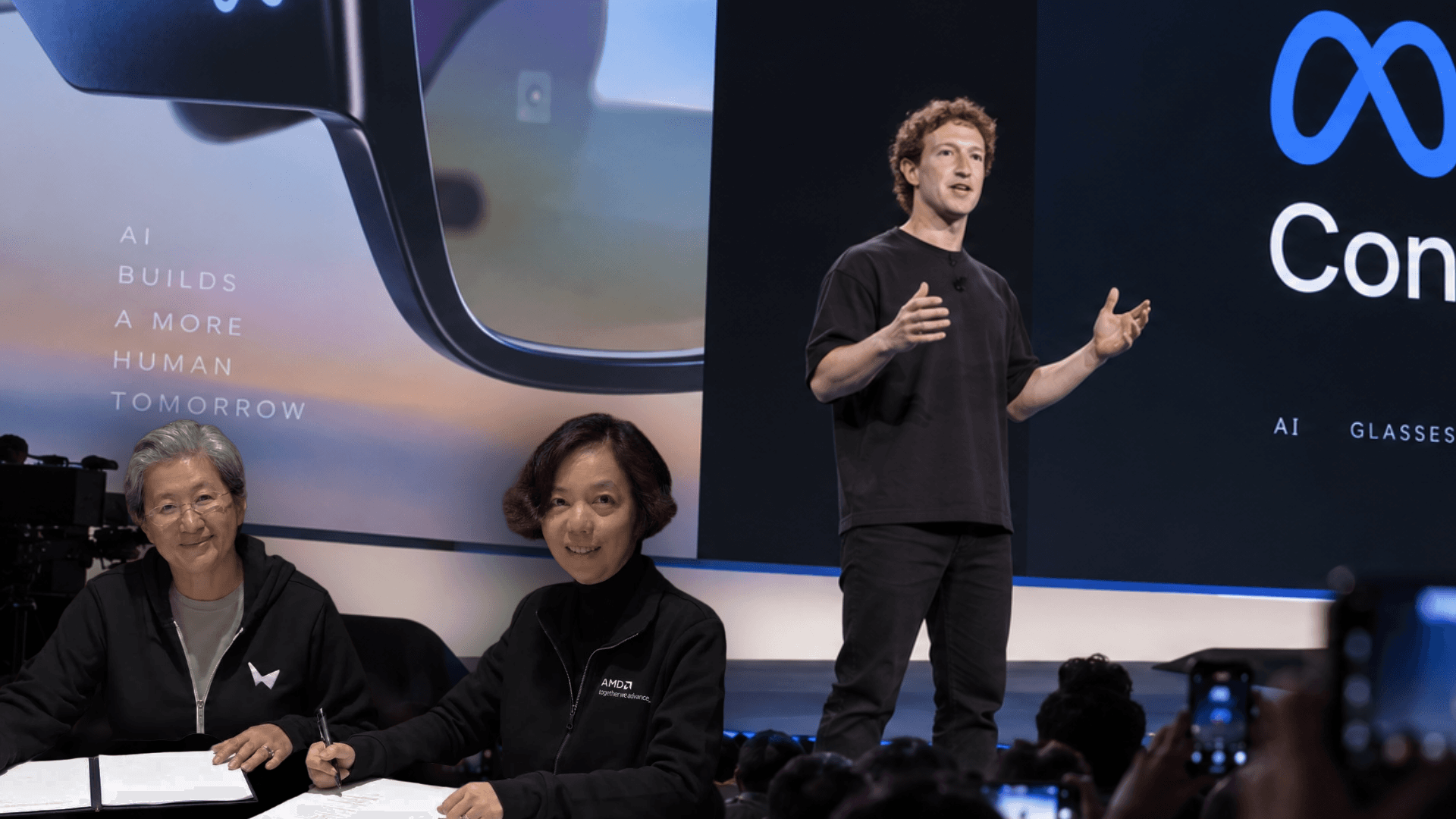
AMD’s proposed acquisition of World Labs for approximately $8.2bn is a clear indication that the infrastructure behind immersive computing is becoming strategically important. World Labs, co-founded by AI researcher Fei-Fei Li, develops models designed to generate and reconstruct persistent three-dimensional environments from text, images and video.
In its announcement, AMD said the all-stock deal would bring World Labs’ research and model capabilities into its wider AI strategy. Li is expected to join AMD as executive vice-president and chief scientist, subject to the transaction closing.
For workplace XR, the relevance is not a new headset or collaboration application. It is the possibility that industrial simulations, digital twins and immersive training environments could become quicker and cheaper to build and adapt. World Labs’ technology is aimed at persistent 3D environments, which are relevant to robotics simulation, physical AI and virtual production as well as immersive experiences.
That does not mean enterprises can yet replace 3D design, engineering validation or operational expertise with generative models. But it does raise the prospect that teams will increasingly use existing images, videos and spatial data as inputs for simulation and visualisation workflows. AMD’s move also adds competitive pressure to NVIDIA, which has been building its own position in world models and robotics.
What Is Spatial AI?
Spatial AI refers to AI systems that can interpret, generate or reason about physical and three-dimensional environments. In an enterprise context, it can support digital twins, robotics simulation, 3D content creation, visual inspection and context-aware XR experiences.
Can AI Finally Lower the Cost of VR Training Content?
Virtual reality training has a well-established role in scenarios where physical practice is expensive, hazardous or difficult to repeat. Yet the cost of producing bespoke modules—and updating them when procedures, equipment or site layouts change—has often limited adoption.
AutoVRse is targeting that bottleneck with VRseBuilder, an AI-assisted platform that turns standard operating procedures into editable VR modules. The company says its tooling can connect AI assistants such as Claude and Cursor to the Unity development engine through Model Context Protocol (MCP), allowing them to assist with scene creation, object changes, asset import and script editing.
AutoVRse claims the approach can reduce custom VR development time by up to 93%, and cut prototype development from around a month to an afternoon. It cites UltraTech Cement as a customer that has deployed more than 40 safety modules across multiple plants.
The claim deserves scrutiny. The 93% figure is based on the vendor’s internal analysis of client project timelines, rather than an independently published study. Faster authoring also does not eliminate the need for source-material preparation, specialist assets, subject-matter review, user-experience testing or ongoing device support.
Still, the direction of travel is significant. If AI can reduce the time required to create and revise training experiences without weakening instructional quality or safety validation, it addresses one of the most persistent barriers to wider enterprise VR deployment.
Key Takeaway
AI-assisted XR authoring may lower production costs, but it does not remove the need for human validation. In safety-critical training, organisations still need subject-matter experts to verify every workflow, instruction and assessment outcome.
How Are Device Management and Enterprise Software Catching Up?
The ability to manage immersive devices alongside the rest of an organisation’s endpoint estate is becoming a baseline requirement. Google’s Android Enterprise framework is now available for Android XR devices, beginning with fully managed Samsung Galaxy XR deployments.
As outlined by the Android Enterprise community, the initial capabilities include zero-touch enrolment, managed Google Play and centrally enforced device policies. Support is available through enterprise mobility management (EMM) providers including Microsoft Intune, Omnissa Workspace ONE, Samsung Knox Manage, SOTI, ArborXR and ManageXR.
That development is not a new consumer feature. It is a signal that XR is being brought into existing information technology (IT) governance and procurement models. For organisations, the practical benefit is avoiding a separate management silo for immersive devices.
Snap is taking a parallel ecosystem approach with its Specs AR glasses. The company has announced business-focused partnerships with Salesforce, NVIDIA and Amazon Web Services (AWS), among others, to support hands-free access to enterprise data and AI capabilities. Reuters reported that the partnerships are aimed at factory, retail and field-service environments, including access to Salesforce Agentforce and AI-supported visual understanding.
The promise is compelling: workers could retrieve business information, complete tasks or receive contextual guidance without switching devices. The harder issue will be integration. Enterprises must determine which workflows genuinely benefit from an in-view interface, and whether their identity, data-access, connectivity and support models are ready for it.
Are Lighter, Camera-Optional Devices Becoming More Relevant?
Recent announcements from Meta and Magic Leap suggest the enterprise hardware conversation is becoming more pragmatic. Comfort, affordability, camera controls and practical AI assistance are increasingly as important as immersion quality.
Meta has outlined a lightweight VR workspace device, due in spring 2027, designed to provide multiple virtual displays, colour passthrough and virtual keyboard functionality. It has also introduced camera-free Ray-Ban Meta Audio glasses, due to begin shipping on 13 October, which offer calls, audio and voice access to AI without image capture.
In The XR Beat’s overview of Meta Connect, Meta also described a private-processing architecture for AI glasses that uses hardware-isolated cloud environments and user-provided encryption keys for persistent-memory features. The company’s ability to translate those principles into enterprise-ready controls and viable application distribution remains an open question.
Magic Leap, meanwhile, has highlighted larger wafers and simpler optical designs as possible ways to reduce waveguide costs for AI display glasses. The wider implication is that the market is pushing towards lightweight devices that can deliver relevant information and AI assistance in the flow of work, rather than relying solely on larger headsets.
For businesses, the critical distinction is between a technically impressive wearable and one that can work within real operational constraints. Camera-free devices may be better suited to restricted sites, while lighter form factors may make longer sessions more feasible. Neither benefit removes the need for security, management, workflow design and user acceptance.
Buyer Checklist: Building an Enterprise XR Programme
-
Governance — Define data capture, retention, access rights and bystander protections before deploying camera-enabled wearables.
-
Device operations — Confirm how devices will be enrolled, updated, secured, supported and retired through existing endpoint-management processes.
-
Content lifecycle — Assess how training or workflow content will be created, validated, updated and governed when procedures change.
-
Workflow fit — Identify specific tasks where hands-free, spatial or immersive interaction offers a measurable advantage over existing tools.
-
Commercial readiness — Separate currently available capabilities from roadmaps, previews and limited developer programmes before making procurement assumptions.
What Should Workplace Technology Leaders Take From This Week?
The strongest enterprise XR stories are no longer simply those that introduce a more capable device. They are the ones that confront the conditions required for a device to become a managed, trusted and useful part of work.
Amazon’s rollout shows that frontline wearables bring privacy questions into sharper focus. AMD’s World Labs deal points to a potentially important change in the economics of spatial content and simulation. AutoVRse illustrates how AI could speed content creation, while Google, Snap, Meta and Magic Leap show that enterprise XR is increasingly being shaped by management, integration, form factor and confidentiality.
The open question is whether these developments will turn fragmented pilots into repeatable programmes. That will depend less on the novelty of XR hardware and more on whether organisations can connect it to the systems, controls and work processes employees already rely on.
Frequently Asked Questions
What is enterprise XR?
Enterprise XR is the use of augmented reality, virtual reality and mixed reality technologies for business applications such as workforce training, frontline guidance, design review, remote assistance, simulation and collaboration.
Why is privacy important for workplace smart glasses?
Camera-equipped smart glasses can capture employees, customers and bystanders while supporting work tasks. Organisations therefore need clear rules for capture, access, retention, security, notification and opt-out where applicable.
What is the value of AI in VR training?
AI can help organisations create and revise immersive training content more quickly, particularly when converting documented procedures into interactive scenarios. Human subject-matter review remains essential, especially for safety-critical workflows.
What does Android Enterprise support mean for XR devices?
It means supported Android XR devices can be managed through enterprise mobility management tools, using capabilities such as zero-touch enrolment, policy controls and managed application distribution.
Are lightweight smart glasses ready for enterprise deployment?
Readiness varies by device, geography, software availability and use case. Buyers should verify what is commercially available today, how applications can be distributed, whether the device meets site policies and how it will integrate with existing identity and endpoint-management systems.