We’re big believers in the idea that XR is going to become a critical part of the workplace in the years ahead, particularly when it comes to learning and skill development. Our own research found that 84% of companies are investing in XR, and 36% say training is their top use case.
Unfortunately, buying headsets and smart glasses is simple, but designing immersive training content that actually affects workplace behavior isn’t.
When companies bite the bullet and decide to handle immersive learning design themselves (rather than just looking for something they can download from an app store), they tend to make a few mistakes. The first one is treating “immersion” as the main goal.
Immersion is just the delivery mechanism. Performance is the result that matters: fewer errors, faster ramp-up, better decisions when conditions aren’t clean or predictable. If performance doesn’t change, XR initiatives get pegged as fun, interesting, or novel, not essential. Budgets move elsewhere, and companies miss out on an incredible opportunity.
Further reading:
- Why Immersive Roleplay is Back in Enterprise Learning
- Enterprise XR: Pain Points and Solutions
- How to Integrate XR into Your Business
What Is Immersive Learning Design?
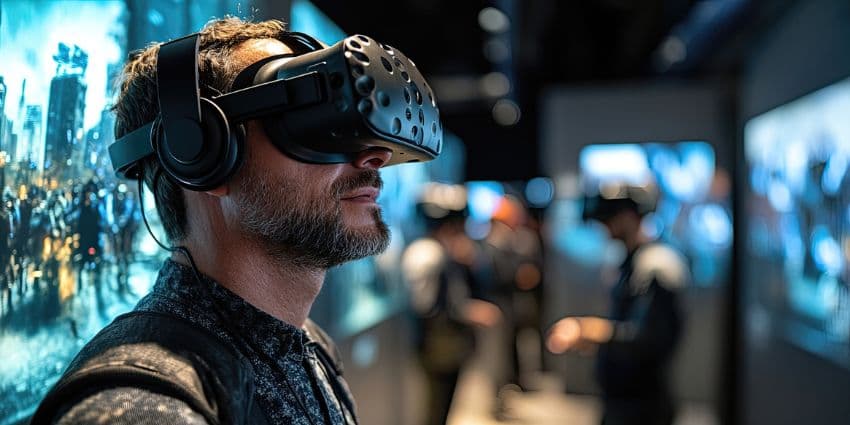
Immersive learning design is how companies create training and development strategies using extended reality technologies. The idea is to place every learner in an interactive, simulated scenario, so they can practice tasks risk-free, in a deeply sensory, engaging environment.
It’s all based on the idea that “practice makes perfect”.
Instead of reading instructions or watching a presentation, employees enter a simulated situation and practice the task. XR technology makes that possible by recreating the environment around them. It might be a factory floor, a retail store, or a customer interaction. The situation feels close enough to real work that the response starts to feel natural.
How Can Immersive Learning Improve Skill Transfer?
The biggest factor is the “learn by doing” experience. You’re not just reading about how to perform a surgery, or fix a complicated piece of machinery. You actually practice doing the task itself.
A huge number of companies, including brands like Verizon and Walmart have already seen how immersive learning can optimize skill transfer.
Skills tend to stick when someone has tried the task themselves. Simulation creates that opportunity. A learner might repair equipment, walk through a safety procedure, or handle a stressful conversation with a customer. Two things make the approach effective. First, the learner can repeat the experience until the response becomes familiar. Second, mistakes don’t carry real-world consequences. That combination turns training into practice rather than explanation.
It’s also a flexible way to learn. Companies are using immersive learning for soft skill development as well as building technical knowledge. People can learn how to handle conflict, deal with difficult customers, and even improve leadership skills.
Why do Some Training Programs Fail to Translate Into Job Performance?
Immersive learning works. There is tons of evidence showing XR content is more memorable and more effective at improving skill development than any traditional classroom strategy. One report from Stanford measured the “training effectiveness” boost at 76%.
The problem comes down to how experiences are designed. Companies still struggle to get results when educational content in XR has:
- No Direct Link to Real Job Tasks: A lot of immersive learning design still models the ideal version of work. Clean sequences. Perfect information. No interruptions. No conflicting priorities. That’s not how real jobs operate. When simulations avoid the real mess, learners learn how to pass the experience, not how to perform in honest conditions.
- No Reinforcement: Skill formation depends on repetition, variation, and feedback. Without those, immersive experiences behave like high-budget awareness tools. Capability forms when people practice the same decisions under slightly different conditions and receive feedback specific enough to change behavior.
- No Measurement Beyond Completion: Completion rates are easy to track. So are satisfaction scores. Neither says much about performance. When immersive programs stop at “who finished” or “who felt confident,” they never earn operational credibility. Leaders care about error rates, time-to-competency, and consistency under pressure.
What Principles Guide Effective Immersive Training Design?
The immersive learning programs, companies, and vendors brag about do things differently. Companies design experiences based on genuine employee friction points. They integrate XR tools with existing skill development strategies, and focus on interactivity, activity, and decision-making, not just “watching things unfold in the metaverse.”
Here’s how companies can master immersive learning design and avoid some of the common pain points with XR deployment.
Choose the Right Type of XR First
One of the easiest ways to sabotage immersive learning design is picking the wrong tool for the job. Not every skill needs the same kind of immersion, and knowledge transfer improves when the XR format matches how the skill is actually used.
VR: Rehearsal and Safe Failure
Virtual reality earns its keep when the consequences are real. When a mistake would cost money, put someone in danger, or turn a tense situation worse fast, VR is hard to beat. It gives people a place to practice tough calls and feel the pressure without learning the lesson the hard way.
That’s why VR shows up repeatedly in leadership training, safety response, and customer-facing scenarios. In one example, Bank of America reported that 97% of associates felt confident applying skills after VR training. Confidence matters here because the situations being trained rarely allow for trial and error on the job.
AR / Smart Glasses: Reinforcement and In-Flow Support
Augmented reality shines later in the learning curve. When people already know the task but struggle with consistency, speed, or accuracy, AR provides guidance at the moment it’s needed.
This is where designing immersive training becomes less about “learning” and more about execution. In manufacturing and field service, small prompts can prevent big mistakes. BMW, using smart glasses from RealWear, completed some repairs 75% faster, largely by reducing hesitation and rework.
Mixed Reality: Spatial Understanding and Complex Systems
Mixed reality sits between rehearsal and reinforcement. It’s most useful when people need to understand how digital information maps onto physical space.
That’s why it’s been effective in engineering and assembly. Boeing reported roughly 25% productivity improvements using AR to guide wiring harness assembly. Spatial clarity reduced errors that documentation alone couldn’t.
Start With Task Fidelity and Transfer-Ready Learning Objectives
A lot of programs begin with mapping XR capabilities, like hand tracking, spatial audio, or photorealistic environments. None of that matters if the experience doesn’t train people to do things differently on the job.
Transfer-ready objectives are about what people actually do, not what they say they understand. If a supervisor can’t watch the behavior change, it’s not a real objective. The strongest goals focus on actions like diagnosing a problem when time is tight, choosing priorities with half the information, or calming a situation that’s already spiraling.
Strong teams pressure-test objectives against reality before anything gets built. They ask:
- Where errors, delays, or escalations actually occur
- Which decisions separate high performers from average ones
Those answers shape the scenario. Not the other way around.
Design for Decision Points, Not Linear Steps
Most immersive training still behaves like a checklist. Do this. Then this. Don’t deviate.
That’s unrealistic, because real work doesn’t reward people for remembering the next step. It rewards people for choosing something when the situation doesn’t line up neatly. Information arrives late. Pressure builds. The “right” answer depends on what just went wrong.
Good immersive learning design leans into that discomfort. It drops learners into moments where the path isn’t obvious and waits to see what they do.
There’s a simple tell. If every learner finishes the scenario the same way, the experience is probably training recall. Not judgment. This is why decision-driven simulations have started replacing procedural walkthroughs in complex environments. In rail operations, Virtualware worked with ADIF to build modular VR scenarios that shift as real operational conditions change.
Sometimes the correct move is to stop or reroute. Sometimes escalation creates more risk than it solves. Learners have to choose anyway. That kind of practice builds real skills that translate to everyday work.
Prioritize Interactivity Over Visual Fidelity
Beautiful environments don’t teach people how to act. They teach people how to look around. That’s fine for a demo. It’s useless for knowledge development.
What actually sticks is movement and choice. Saying something out loud. Picking the wrong option. Hesitating. Recovering. Those moments force the brain to work in the same way it does on the job.
In weak immersive learning design, learners spend most of the session watching. Listening. Waiting for the system to tell them what to do next. That’s not practicing something; it’s just consuming content. In strong immersive training, learners interact.
Healthcare training shows this clearly. Transfr reported up to 50% knowledge gains when learners practiced clinical decisions inside interactive simulations instead of consuming traditional instruction.
Interactivity also leaves a trail. Every choice exposes something. That’s what makes immersive learning optimization possible in the first place.
Design Realistic Models and Scenarios Strategically
Realism is expensive, and attention is limited. Not everything deserves detail. If you’re using smart glasses over VR, for instance, the visuals tend to matter a lot less. The type of skills you’re developing changes things too.
Some skills demand accuracy, spatial judgment, equipment handling, and safety checks. In those moments, realism matters. But realism everywhere is noise. Extra detail pulls attention away from the decision that actually matters.
Strong immersive learning design is selective. It sharpens the parts of the environment that support judgment and simplifies everything else.