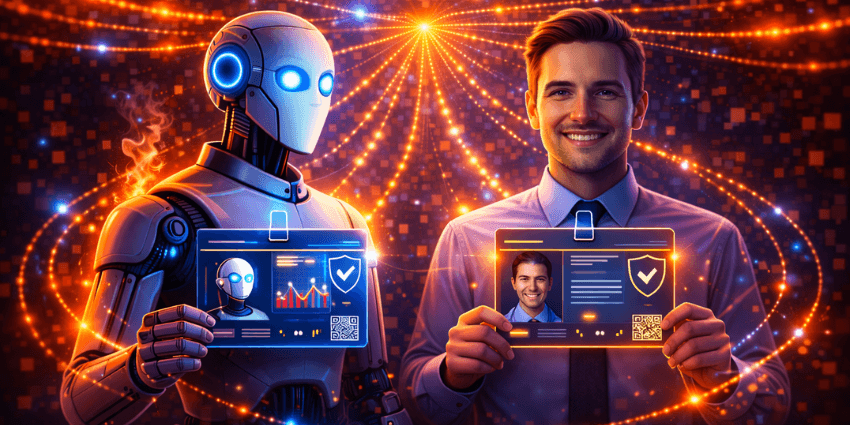
The days of treating AI bots and copilots as handy tools are over. We’re officially in the age of the machine colleague, where intelligent tools aren’t just completing tasks, they’re delegating work, organizing teams, and even making judgment calls.
That’s why identity assurance for AI has become so essential. When an AI writes the summary, assigns the work, and frames what “happened,” it becomes part of the decision chain. That’s not a productivity layer. That’s authority by proxy, and authority needs governance.
The trouble is that UC and collaboration platforms were built to answer a simpler question. Who logged in? They were never designed to prove who actually decided, approved, or acted when humans and systems are working side by side.
Attackers have noticed. Microsoft has publicly warned about financially motivated groups using Teams phishing to establish footholds. Verizon’s DBIR still shows social engineering as one of the most reliable ways in. When trust is assumed, it’s easy to borrow.
Further reading:
What Is Identity Assurance in Unified Communications?
Identity assurance in unified communications is the difference between recognizing a name and being able to trust the action.
That sounds obvious, but it’s not how most collaboration stacks still behave. In formal identity guidance, NIST treats assurance as separate layers: proving who something is in the first place, proving it is authenticated correctly, and proving identity claims can be trusted when they’re passed between systems. NIST now frames those as Identity Assurance Level, Authentication Assurance Level, and Federation Assurance Level.
That’s a useful way to think about UC, because modern collaboration doesn’t stay inside one neat login event. It moves across meetings, chat, guests, apps, and federated services.
So in practical terms, identity assurance in UC means this: when something important happens, a decision, an approval, a file share, a task creation, a policy change, you can show who or what acted, how strongly that identity was verified, what system vouched for it, and whether the level of confidence matched the risk of the moment. That is a much higher bar than “the user had a valid session.”
Why does that matter now? Because attackers don’t need to smash their way in. They can borrow trust. Microsoft has documented Teams attacks where threat actors built rapport in chat, masqueraded as meeting invites, captured tokens through device-code flows, and then used valid tokens and Teams APIs to impersonate users.
That’s why identity assurance in UC is really about confidence under pressure. Not “did someone log in?” but “can we defend who initiated this, who approved it, and whether the platform should have trusted it at all?”
Why Do AI Bots Need Identities In Communication Platforms?
Unified communications runs on borrowed trust.
If someone’s in the meeting, camera on, using the right name, we assume legitimacy. If a message shows up in Teams or Slack, we treat it as internal by default. That mental shortcut made sense when collaboration tools were mostly human, mostly synchronous, and mostly disposable.
AI shattered the old trust signals first. Voice and video feel convincing until they aren’t. Writing style looks authentic until a model learns it better than the person it’s copying. The Arup deepfake meeting fraud didn’t work because people were careless. It worked because meetings still feel final. Authority plus urgency shuts down doubt fast. Roughly $25 million moved because everyone in the room believed presence equaled proof.
At the same time, UC identity assurance still treats authentication like a box you tick once. Log in. Pass MFA. From that moment on, the system mostly stops asking questions. But collaboration doesn’t stay in one lane. A status call turns into a budget decision. A “quick sync” turns into approval to change vendor payment details.
Now layer in AI agent identity. Copilots summarizing conversations. Bots assigning tasks. Agents kicking off workflows. Actions still look human. Outcomes still land in human spaces. But responsibility starts to smear. Was that decision made by a person, shaped by an AI, or executed automatically because no one slowed it down?
This is where non-human identity turns into a governance problem. If you can’t clearly prove who initiated, who approved, and who actually acted, investigations become archaeology.
How Can Organizations Authenticate AI Agents In Collaboration Systems?
Once you look for it, the pattern is hard to ignore. Human identity failures and machine identity failures don’t cause different problems. They cause the same problems, just at different speeds.
Most AI agents aren’t named in identity systems. They inherit permissions, act through APIs, and don’t have an obvious owner. When something goes wrong, there’s no clean answer to a simple question: who was responsible for that action?
That’s the real break. When identity falls apart, access control isn’t the first thing you lose. You lose the story. You lose the ability to explain how a decision actually happened. And once that’s gone, everything that follows gets heavier than it should be. Reviews drag. Investigations stall. Risk creeps in where it never needed to exist.
What Are the Identity Types in UC Platforms?
This is where things usually start going wrong, long before anyone talks about AI risk or attackers. People don’t agree on who or what is actually allowed to act inside collaboration. So everything gets lumped together, and nobody notices until something breaks. You’ve got:
- People with accounts: Employees, contractors, execs. The obvious ones. The problem isn’t that they exist; it’s that authority slides around inside meetings without anyone naming it.
- Guests who quietly become insiders: Vendors, partners, advisors. Someone invites them to a channel or a recurring call because it’s faster than forwarding notes. Weeks turn into months.
- Bots and integrations that never go away: These are the ones everyone forgets about. A workflow gets added to keep tickets moving. A bot posts summaries. An integration syncs data between systems. Nobody removes access when the project ends because nothing breaks obviously.
- AI agents acting for people: Agents write summaries, create tasks, and update records without waiting for someone to double-check them. Gartner says this kind of agentic behavior will be built into a huge share of enterprise software within a year or two. Yet most teams still rely on vibes instead of explicit delegation.
That’s how non-human identity turns into a problem without anyone meaning it to. Not through some dramatic failure, but through a hundred small decisions nobody thought needed rules.
How Does Attribution Support Identity Assurance?
Attribution forces you to slow down and be precise, and collaboration culture hates that. Everyone just wants to keep things moving. But when UC identity assurance fails, it’s usually because attribution was unclear long before anything went wrong.
In modern UC, especially once AI agent identity enters the picture, there are at least three roles tangled together unless you deliberately pull them apart:
- The actor of record: The thing that executed the action. Sometimes that’s a person. Increasingly, it’s an agent or workflow. Meeting summaries posted automatically. Tickets created without anyone touching them.
- The initiator: The human who set things in motion. The person who asked for the summary. The manager who said, “Can you follow up on this?” That intent often lives in conversation, not in logs.
- The approver: The one who had the authority to say yes. This is where things get risky. In meetings, approval is often implied. A nod. Silence. A rushed “sounds good.” Collaboration tools were never built to capture these moments as formal approvals, even though the business treats them that way later.
When those roles blur, accountability evaporates. It gets worse with non-human identity, because agents don’t hesitate. They act cleanly, quickly, and without context. The output looks legitimate. The artifact travels. By the time someone questions it, the decision has already hardened.
Good attribution doesn’t mean slowing work to a crawl. It means being honest about who initiated, who approved, and what actually carried out the action.
How Does Session-Level Tracking Improve Identity Assurance?
This is where a lot of identity thinking is stuck, and it shows. Log in. Pass MFA. Box checked. From there, every moment gets treated like it carries the same level of risk.
Anyone who’s survived a long meeting knows that’s a fantasy. Ten minutes of routine updates. Someone drops in late. A casual question about timing turns into a real call about money or priority. Then the meeting ends, the transcript gets saved, and suddenly it all looks tidy. Like the decision was obvious. Like it was planned that way.
Now add AI agent identity. Agents don’t feel hesitation. They don’t sense discomfort. If they’re allowed to act, they act. Summaries get posted. Tasks get created. Follow-ups go out while people are still packing up their thoughts.