XR has spent years in “cool demo” territory – great on a show floor, much harder to plug into a real business case.
Lenovo and Arthur believe that phase is over.
At ISE 2026 in Barcelona, Lenovo’s XR stand was “overrun by customers and partners” on just the second day, according to Oliver Woehler, XR Sales Lead EMEA at Lenovo.
Crucially, the conversations weren’t about gadgets; they focused on use cases, savings, and speed to value – how to cut travel, improve unproductive meetings, and make training more scalable.
By combining AI with immersive collaboration, training, and digital twins, Lenovo and Arthur are positioning enterprise XR as something IT and business leaders can actually roll out, support, and measure – not just an experiment.
From Devices to Workflows
Lenovo’s message at ISE 2026 was clear: the era of selling headsets for their own sake is over.
“No one is buying an XR headset only because it’s an XR headset,” Woehler said. “You need to do something quicker, faster, easier, and cheaper.”
That is the lens Lenovo is using to frame every XR conversation. Rather than pushing generic “XR capability”, the company is building a curated ecosystem of software partners around specific, repeatable workflows in collaboration, training, and digital twins. Arthur is one of the flagship partners in its “smart collaboration” environment.
Lenovo’s broader goal is to support the full content workflow, regardless of device, so XR can sit naturally alongside existing endpoints.
“You can consume the content on 2D screens, 3D screens, laptops, tablets, and, of course, XR headsets,” Woehler said.
“This is what Lenovo is doing to help the customer on every level, in every area.”
For IT leaders, that framing matters. XR is treated as another endpoint in the digital workplace – integrated, managed, and secured within the existing stack – rather than as a separate, experimental island.
AI in the Room: Arthur’s Approach
Arthur has been in the enterprise VR market for around a decade.
The breakthrough in the last two years, according to Arthur Sales Associate, Laura Keresztyén, is the “match made in heaven” between AI and VR.
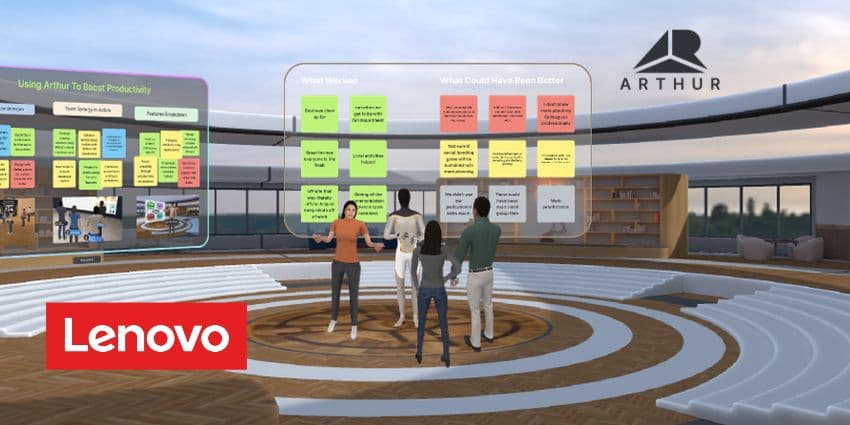
AI in Arthur isn’t just a chatbot off to the side – it appears as an embodied avatar inside the virtual space, able to act as a genuine participant and facilitator.
“This AI basically is an embodied avatar that can, just the same way as we humans, interact with the space, be an active participant, wearing many, many hats,” Keresztyén said.
In meetings, the AI helps teams decide what to focus on, organise ideas as they emerge, and proactively suggest next steps and actions. For leaders frustrated by meetings that meander and never quite land, this is about discipline and follow-through as much as it is about immersion. With teams spread across locations and time zones, that support is aimed at making the most of hard‑won meeting time, not just “meeting in VR for the sake of it”.
“It’s so hard to really find the right time in your calendar, especially if it’s five people or 10 people,” she noted.
“You might as well use it efficiently – and that’s where the AI helps keep you on the agenda and actually follow through on what needs to get done.”
Fast ROI and Immersive Training
Both Lenovo and Arthur see training as one of the fastest paths to a tangible return on XR, particularly for organisations with high training volumes, safety‑critical environments, or distributed workforces.
“We see a lot of customer demand on the training side,” Woehler said.
“Training scenarios are very easy to integrate into XR scenarios. With that, you can create a quick return on investment.”
The logic is straightforward. Many training programmes are already expensive to deliver, difficult to standardise, and constrained by access to real equipment or sites. Moving those scenarios into XR allows organisations to simulate realistic situations safely, repeat them as often as needed, and reach more people without adding more travel and facility cost.