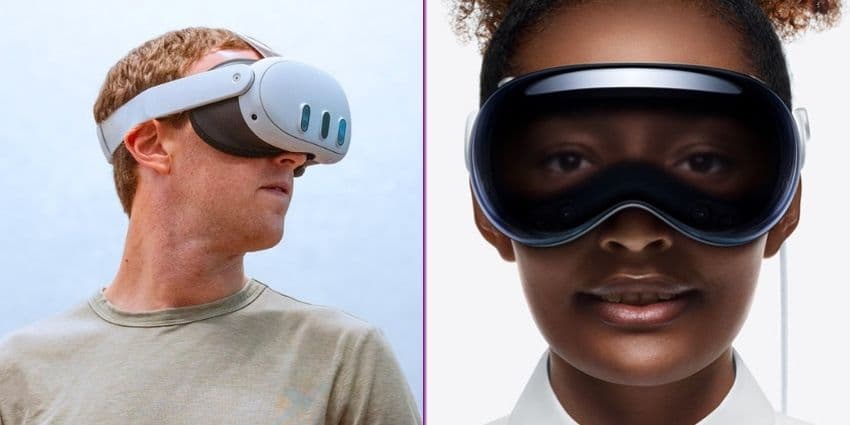
Apple Vision Pro vs Meta Quest 3: Which is the best headset?
Both options have been available to the public for a little while now, and both have made quite an impact on consumers. After testing both of these headsets, it’s easy to see why.
The Meta Quest 3 is easily the best headset Meta has created so far—not just when compared to the previous Quest 2. It even has an edge over the Quest Pro in some areas.
Apple’s proprietary XR headset is revolutionary in its own way, introducing us to a new era of “spatial computing.” But with its hefty price tag, it’s not as accessible as the Quest 3 for most people.
Still, pricing aside, which headset is worth investing in, and why?
I put the two devices head-to-head to give you my honest opinion.
Apple Vision Pro vs Meta Quest 3: Our Quick Verdict
The Apple Vision Pro feels like the beginning of a new era for mixed reality headsets. It’s one of the most powerful devices I’ve ever used, with exceptional multi-tasking capabilities, hand and eye-tracking, and phenomenal visual fidelity.
The Meta Quest 3, on the other hand, isn’t quite as mind-blowing, but it’s definitely the more affordable option for XR beginners. It’s also the slightly more ergonomic choice, although that hasn’t stopped countless consumers from wearing their Apple Vision Pro wherever and whenever possible.
Apple Vision Pro vs Meta Quest 3: What Users Are Saying
Before I compare Apple and Meta’s latest headsets, I thought I’d look at what other users thought, starting with Meta's head, Mark Zuckerberg. A couple of weeks after the Apple Vision Pro was released, Zuckerberg shared his review.
Shockingly, he says the Quest 3 isn’t just better value; it’s the better product overall. This opinion is likely to be a bit biased, but Zuckerberg does make a good point about value for money. The Quest 3 is a lot cheaper and still competes with the Vision Pro in many ways.
Zuckerberg isn’t the only person who prefers the Quest 3, either. A poll conducted by 360Rumors found that 73% of people would rather use the Quest 3 over the Vision Pro.
Notably, though, the results could have something to do with the people surveyed. I think the Meta Quest 3 will likely be more appealing to everyday consumers. However, the Vision Pro represents an incredible opportunity for professional teams. Not only is it better for everyday work (I’ll talk more about this below), but it also features apps for things like surgical training.
Apple Vision Pro vs Meta Quest 3: The Specs
Now let’s move onto my comparison of the Apple Vision Pro vs Meta Quest 3. First, it’s worth noting both companies define their headsets a little differently. Apple says the Vision Pro is a spatial computing system offering mixed-reality as-standard. The Meta Quest 3 is still being described as a “virtual reality headset.” However, it does provide mixed reality capabilities.
The Meta Quest 3 was recently updated to feature a new “Layout” system, which mimics some of the spatial computing features of Apple’s headset. Despite their massive difference in price, Meta and Apple’s headset share many similarities. Let’s look at the specs side-by-side.
| Meta Quest 3 | Apple Vision Pro | |
| Price | Starting at $499 | Starting at $3,499 |
| Display | LCD 2064 x 2208 pixels per eye at 120Hz | OLED 2160 x 3840 pixels per eye at 100HZ |
| Lenses | Pancake | Pancake |
| Processors | Qualcomm Snapdragon XR2 Gen 2 | Apple R1 and M2 |
| Controllers | Hand tracking, plus Touch Plus, controllers | Hand and eye tracking |
| RAM | 8GB | 16GB |
| Storage | 128GB and 512GB | 256GB, 512GB, 1TB |
| Weight | 513g | 600-650g |
| Battery life | 2-3 hours | 2-3 hours |
Apple Vision Pro vs Meta Quest 3: Pricing
Pricing is one area where the Meta Quest 3 has a clear edge over Apple. All of Meta’s headsets are usually reasonably affordable, making them more accessible to the masses.
The Meta Quest 3 is no exception, starting at a reasonable $499. In fact, I’d rank the Quest 3 as one of the best value affordable headsets out there. On the other hand, prices for the Apple Vision Pro start at $3,499. It’s pretty impressive that it sold out so quickly at that price.
Notably, it’s not just the Quest headset itself that’s cheaper. The accessories are more affordable, too. Even the carry cases for the Quest 3 start at $70 compared to Apple’s case costing around $199. The prescription lenses for the Quest 3 start at $50, too – half the price of the Zeiss lenses for reading and a third of the cost of prescription lenses for the Vision Pro.
Still, the Vision Pro is a more “premium” product overall. It feels and looks more expensive than the Meta Quest 3, which is probably why Apple isn’t struggling too much to make sales.
Apple Vision Pro vs Meta Quest 3: The Design
If I were rating the Quest 3 and Apple Vision Pro on looks alone, Apple’s headset would win. Its design is a lot sleeker and more futuristic. Plus, it comes with features Meta hasn’t been able to replicate. For instance, the 3D laminated glass can reflect an image of your eyes to the people around you. That might be a weird feature, but it’s still a differentiator.
As I noted in my Quest 3 review, the headset doesn’t look that different from any other Meta headset. You still get the white, plastic aesthetic and the chunky visor.
Still, looks aren’t everything, and the Quest 3 has an edge over the Vision Pro in terms of comfort, particularly regarding weight. I’ve commented on the Apple Vision Pro’s weight before. Though there are heavier headsets out there, the extra 20% heft compared to the Meta Quest 3 really does make a difference over time.
The Quest 3 balances weight more effectively on your head and ensures you can continue using it for longer periods. That being said, the strap isn’t the best. I’d advise upgrading to an Elite strap for a snugger fit if you can afford it.
The problem with the Vision Pro is that it’s not just heavier – it also carries all of its weight on the front due to the lack of a built-in battery. Even with an advanced headband (like the Dual Loop), wearing this headset after a while is exhausting.
One thing Apple does do a little better than Meta is tailor its headset to your face. You can upload a scan of your face to Apple’s store, and they’ll custom-fit the headset for you. They even recommend the right light shields for extra comfort. Still, this does mean you’ll have a harder time sharing your headset with friends and colleagues.
Meta vs Apple: The Displays and Audio
One thing that stood out in my Apple Vision Pro vs Meta Quest 3 experiment was the visual fidelity. The Quest 3 gives you a significant upgrade in visual performance. You get 2064 x 2206 pixels per eye at refresh rates up to 120Hz. Plus, even in passthrough mode, the Quest 3 delivers ten times more pixels than the Quest 2.
The Quest 3 even outshines the enterprise-grade Meta Quest Pro in visual performance, but it still struggles to compete with the Apple Vision Pro. With the Vision Pro, you get around a 4K level of fidelity per eye at a refresh rate of 100Hz.
I noted in my review of the Apple Vision Pro that the visuals are incredible. Even in passthrough, I found the Vision Pro offers much more clarity.
If I had only ever used Quest devices, the Quest 3 would be potentially mind-blowing, but it just feels mediocre in comparison to Apple’s ultra-rich experience.
From an audio perspective, Meta has upgraded its spatial audio to be more realistic, using a new HRTF model. This makes a difference in how sounds seem to be “positioned” around your head when interacting with the digital world.