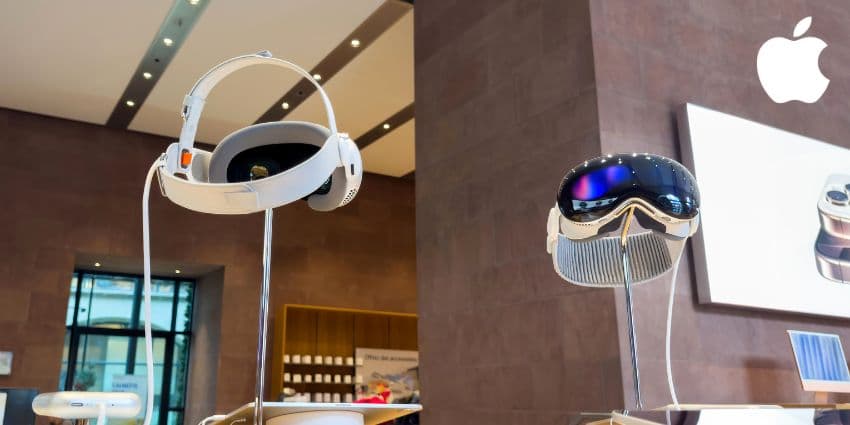
Apple’s bold first step into XR with the Vision Pro was pitched as the ‘future of computing’ but quickly ran into a hard reality: $3,499 was simply too steep for what many business leaders and enterprise IT buyers considered an experimental device.
Now, with the Apple Vision Pro 2, set to arrive between late 2025 and early 2026, expectations are high – but the pressure is on. Will Apple’s refined spatial computing play into something truly enterprise-ready, or risk repeating the same missteps?
Rumored Features of the Apple Vision Pro 2
Next-Gen Chip: M5
The Vision Pro 2 is likely to feature Apple’s new revolutionary M5 chip, a generational leap over the M2 in the first model. Faster processing, improved thermal efficiency, and longer battery life - XR’s holy trinity of compatibility - could finally deliver the consistency enterprise deployments demand, particularly in training simulations and design workflows where latency is costly.
Enhanced AI Performance
Apple’s upgraded neural engine could accelerate AI-driven environment mapping and persona rendering. This means more natural collaboration in hybrid offices, with spatial avatars and environments running more seamlessly than before.
Software & visionOS Evolution
Apple’s software push is perhaps the most business-relevant shift. visionOS 26, previewed in June 2025, introduces AI-generated spatial scenes, advanced widget integration, and even PlayStation VR2 controller support, showing Apple is serious about expanding use cases. With Apple Intelligence baked into the OS, the Vision Pro 2 could become less of a novelty and more of a practical enterprise tool.
Improved Comfort with New Head Strap
Weight and ergonomics were among the top complaints with the first headset. A redesigned head strap promises reduced strain, addressing one of the major blockers for extended workplace use – critical for industries like healthcare and engineering where multi-hour sessions are the norm.
Release Date & Market Expectations
Reports suggest mass production will begin in Q3 2025, pointing to a late-2025 launch. But timing isn’t the only factor. The real question for IT buyers will be ROI. Businesses that held back on the first Vision Pro may approach the sequel with skepticism, looking for stronger evidence of productivity gains before committing.
Vision Pro vs Vision Pro 2
- Comfort & Wearability: New strap design directly addresses widespread user fatigue complaints.
- Software Evolution: Vision Pro 2 will ship with the latest visionOS, far more integrated with AI than the original.
- Design Philosophy: Minimal external changes, signaling refinement rather than reinvention.
For enterprises, the subtle but significant upgrades could be the difference between pilot projects and wider adoption.
Vision Pro 2 vs. Apple Vision Air: A Strategic Split
Here’s where it gets interesting: Apple is also expected to release the Vision Air, a lighter, more affordable headset targeting mainstream adoption. For businesses, this split raises critical questions:
Vision Pro 2: High-performance, premium, enterprise-focused device. Best suited for design, medical imaging, immersive training, and executive-level collaboration.